Marketing
At its core, a performance marketing agency is your partner in a specific kind of advertising—one where you only pay when you get a result. Forget just paying for exposure; here, you pay for actions like a click, a new lead, or, best of all, a completed sale. It’s a completely data-led approach that makes every single rupee of your marketing budget accountable.
Why Performance Marketing Is a Game Changer for Growth
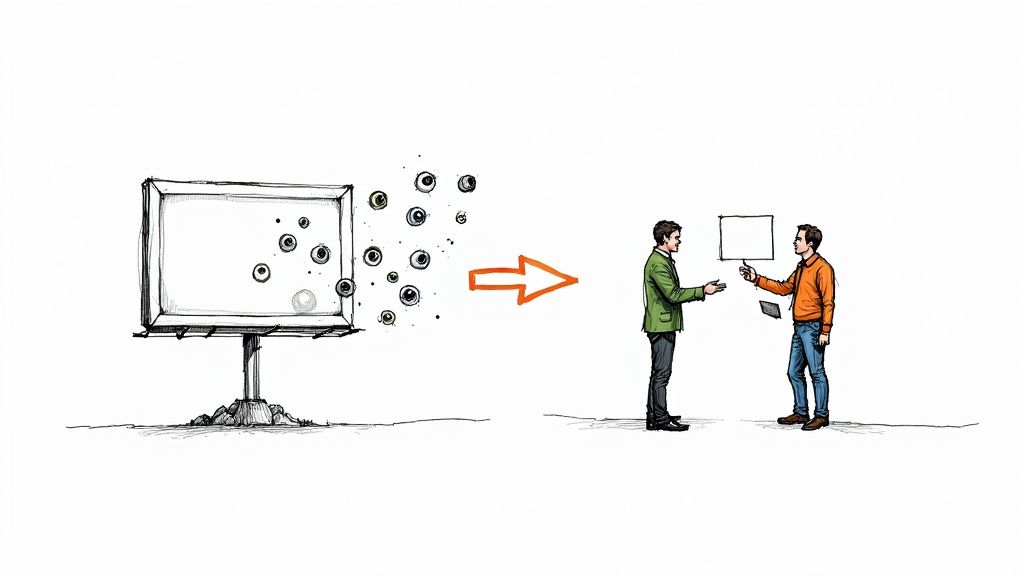
Think about traditional advertising. You might spend a fortune on a massive billboard on a busy highway. You pay a huge fee upfront, crossing your fingers that the right people see it and eventually decide to buy from you. You’re essentially paying for potential eyeballs, with zero guarantee of a return.
Now, let’s flip that script. Imagine you only paid a salesperson a commission when they actually closed a deal. That’s the heart of performance marketing. It directly ties every rupee you spend to a tangible business outcome. This is a massive shift from paying for vague “impressions” to investing in concrete actions that directly grow your business.
A Model Built on Accountability
The real beauty of a performance marketing agency is its total accountability. Their success is tied directly to yours—if you don’t get results, they don’t either. This simple fact transforms marketing from a cost centre into a predictable growth engine. You’re no longer guessing about the impact of your ad spend; you’re tracking every click, lead, and sale, and calculating your return on investment down to the last paisa.
“Performance marketing is rooted in precision and results. Its primary focus is on driving measurable actions, such as conversions, sales, or leads, by optimising campaigns for maximum efficiency.”
This is precisely why so many modern businesses are shifting their budgets. They’re not just buying ad space anymore; they’re buying outcomes. This laser focus on real results is what allows businesses to scale with confidence and efficiency. You can dive deeper into how this mindset fuels business development by exploring strategies for agency growth.
Thriving in a Data-Driven Market
This move towards performance-based models isn’t just a fleeting trend—it’s the new reality, especially in fast-growing markets. India’s digital advertising space has exploded, with performance marketing leading the charge.
Projections show that by 2025, digital ad spend in India is expected to hit ₹52,992 crores, making up 44% of the total advertising market share. This growth is overwhelmingly powered by the demand for measurable outcomes. This highlights a clear market shift towards strategies that deliver verifiable results, making a skilled performance marketing agency a crucial partner for any company serious about growth.
Understanding an Agency’s Core Services
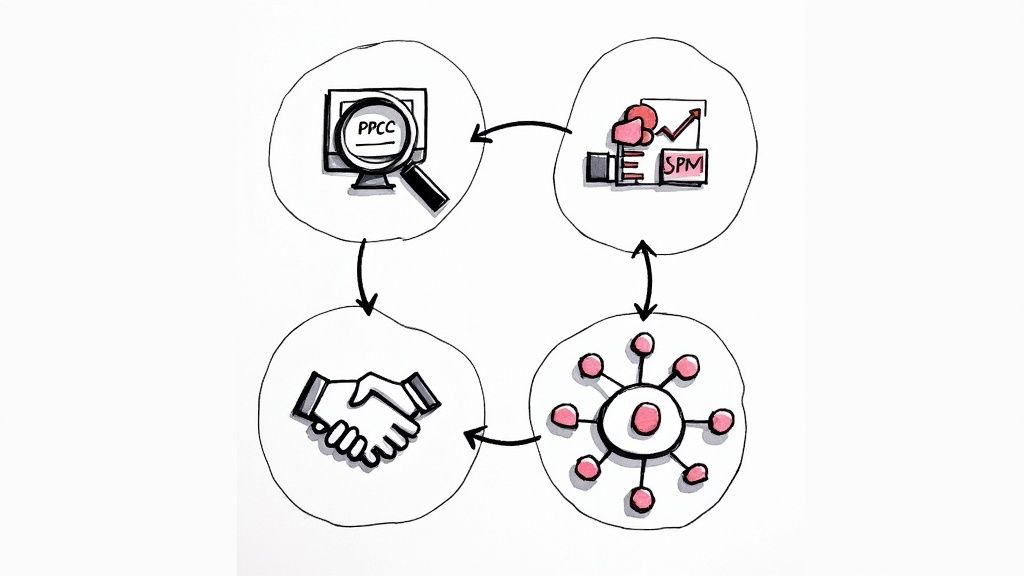
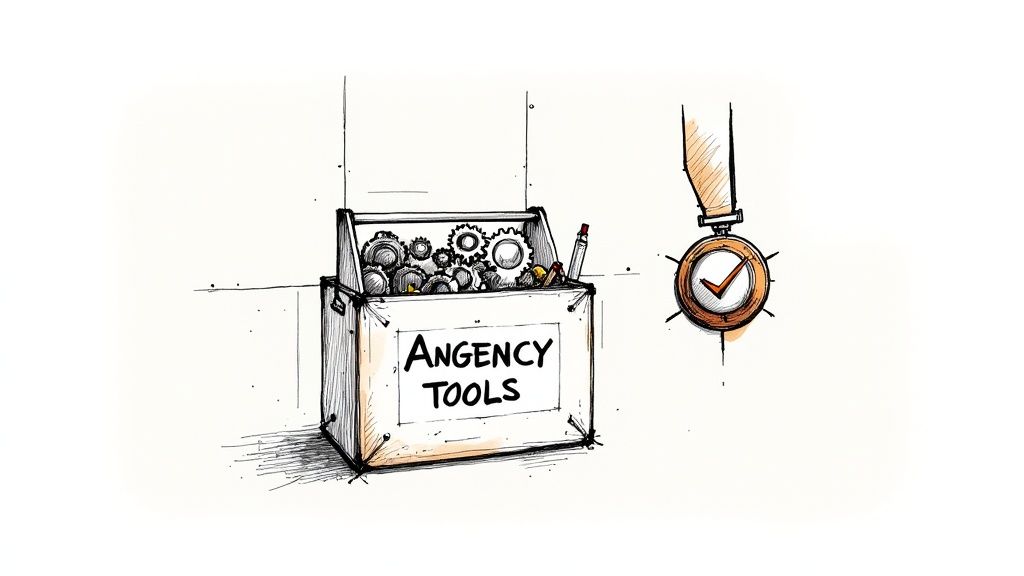
A top-tier performance marketing agency does more than just place ads. They are masters of a multi-channel symphony, where every instrument plays a specific, measurable role. Think of their services less as a checklist and more as a specialist’s toolkit—the real magic is in knowing which tool to use, when, and how to combine them for the best result.
These core services aren’t standalone tactics; they’re designed to work together as part of a single, unified strategy. Each channel is carefully selected to engage your ideal customers at different points in their journey, from the first spark of interest to the final click to buy.
Let’s unpack the most essential services you’ll come across.
Paid Search: Capturing Active Intent
Paid search, commonly known as Pay-Per-Click (PPC), is the workhorse of performance marketing. It’s about getting your brand in front of people who are already looking for what you offer. It’s like setting up your shop right where a customer is actively searching for a solution.
Real-World Example: Someone types “best running shoes for flat feet” into Google. They aren’t just browsing; they have a specific problem and are seeking an immediate answer. A sharp agency ensures your ad for specialised running shoes is the first, most compelling result they see. The objective is crystal clear: turn that high-intent search into a website visit and a sale.
Best Practice: Effective PPC involves more than just bidding on keywords. A top agency will focus on optimising ad copy for a high click-through rate (CTR), building high-converting landing pages, and using negative keywords to filter out irrelevant traffic, ensuring every ad rupee is spent on potential customers.
Social Media Advertising: Building Targeted Audiences
If paid search captures existing demand, social media advertising creates it. Platforms like Meta (Facebook and Instagram) and LinkedIn offer incredibly detailed targeting options. This lets an agency build highly specific audiences based on demographics, interests, past behaviours, and more.
Real-World Example: Imagine you sell sustainable yoga mats. A performance agency can build a campaign targeting people who follow famous yoga instructors, are members of wellness groups on Facebook, and have shown interest in eco-friendly products. You aren’t just waiting for them to search for you; you’re introducing your product directly to the people most likely to love it.
A truly effective strategy combines multiple channels. It uses social media to introduce the brand to a perfectly matched audience and then uses paid search to be present when that newly aware audience decides to actively look for the product.
Affiliate Marketing: Leveraging Partnerships for Sales
Affiliate marketing is a true pay-for-performance model. You partner with affiliates—like bloggers, influencers, or review sites—who promote your product to their own followers. In return, you pay them a commission, but only when they generate an actual sale.
Real-World Example: A popular tech reviewer features your new software in their latest YouTube video and includes a unique tracking link in the description. You only pay them a percentage when someone clicks that specific link and completes a purchase. It’s an incredibly low-risk way to broaden your reach, as you’re paying for guaranteed results, not just views or clicks.
You can dive deeper into how different channels fit together in our guides on digital advertising.
Programmatic Display: Automating Ad Buying at Scale
Programmatic display advertising uses sophisticated, automated technology to buy ad space in real-time across millions of websites. Instead of an agency manually negotiating placements, software bids on ad impressions targeted to specific user profiles.
This allows for massive scale and pinpoint accuracy. Your ad for travel backpacks, for instance, could automatically pop up on travel blogs, flight booking sites, and weather apps—but only when viewed by someone who has recently been searching for holiday destinations. It’s a hyper-efficient way to maintain brand visibility with the right people all over the web.
Comparing Core Performance Marketing Channels
To bring it all together, this table breaks down the primary channels, what they’re best at, where they operate, and how success is measured.
| Channel | Best For | Key Platforms | Primary Metric |
|---|---|---|---|
| Paid Search (PPC) | Capturing high-intent customers actively searching | Google Ads, Microsoft Ads | Cost Per Acquisition |
| Social Media Ads | Building brand awareness and creating new demand | Meta (Facebook, IG), LinkedIn | Return On Ad Spend |
| Affiliate Marketing | Low-risk, commission-based sales generation | Partner Networks, Influencers | Cost Per Sale |
| Programmatic Display | Large-scale brand visibility and retargeting | Demand-Side Platforms (DSPs) | Impressions, View-Through Conversions |
Each of these channels serves a distinct purpose, and a skilled agency will create a bespoke mix that aligns perfectly with your business goals.
The Metrics That Actually Matter
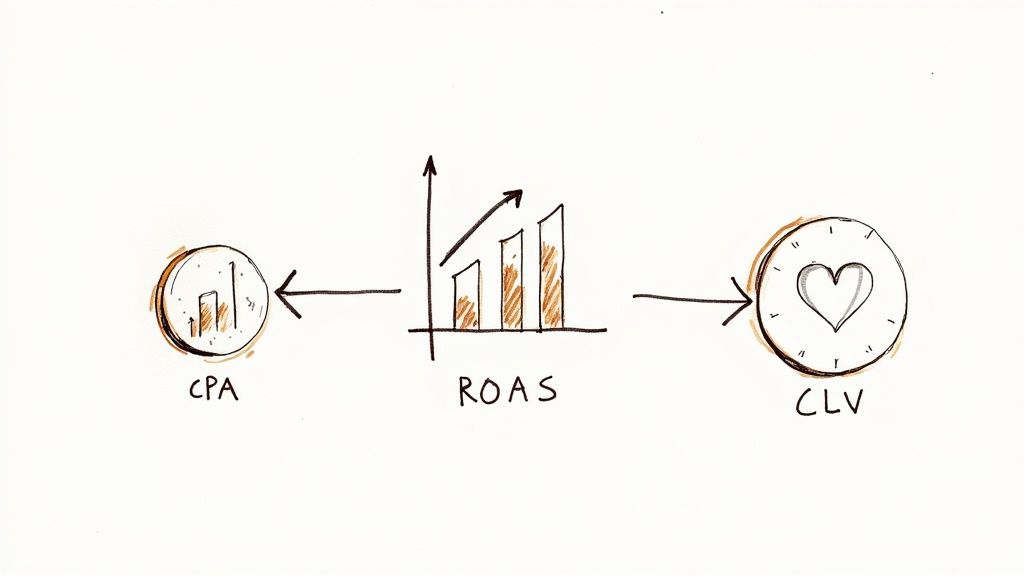
In performance marketing, the numbers have to do the talking. But not all numbers are created equal. It’s easy to get distracted by vanity metrics like ‘likes’ or ‘impressions’ that might look impressive on a report but don’t actually pay the bills.
A real performance marketing agency cuts through the noise. They zero in on the key performance indicators (KPIs) that connect directly to your business growth and profitability. Understanding these core metrics is vital for judging an agency’s real impact on your bottom line.
Cost Per Acquisition (CPA)
Let’s start with a foundational one: Cost Per Acquisition (CPA). Simply put, this is what it costs you, on average, to win a single new customer from a specific campaign. You calculate it by dividing your total campaign spend by the number of new customers acquired.
Real-World Example: Imagine you spend ₹10,000 on a Google Ads campaign and it brings in 50 new customers. Your CPA is ₹200. It’s a straightforward, powerful measure of efficiency.
Actionable Insight: Chasing the lowest possible CPA can be a trap. A cheap customer isn’t necessarily a good one. A best practice is to define an ideal CPA based on your product’s profit margin and customer lifetime value, not just industry benchmarks. An agency focused on a rock-bottom CPA might acquire low-value customers who make one tiny purchase and disappear forever.
Return On Ad Spend (ROAS)
While CPA is about cost, Return On Ad Spend (ROAS) is all about profitability. It answers the most important question: for every rupee you put into advertising, how many rupees are you getting back?
ROAS is your campaign’s total revenue divided by its total cost. A ROAS of 5x means you earned ₹5 for every ₹1 spent.
Let’s go back to our example. The campaign had a ₹200 CPA. If those 50 customers each spent ₹1,500, your total revenue is ₹75,000. Your ROAS would be ₹75,000 (revenue) ÷ ₹10,000 (cost), which equals a healthy 7.5x. This proves your ad spend is a profitable investment, not just an expense.
Customer Lifetime Value (CLV)
The most strategic agencies don’t just think about the first sale; they focus on Customer Lifetime Value (CLV). This metric forecasts the total profit your business can expect from a single customer over their entire relationship with you.
Actionable Insight: A top-tier agency uses CLV to guide its strategy, ensuring you’re not just buying customers, but investing in relationships that pay dividends. They might recommend a higher CPA for acquiring customers through a channel known to produce loyal, repeat buyers.
- Campaign A: Gets a low CPA of ₹200, but these customers only spend ₹500 on average and never buy again. Their CLV is ₹500.
- Campaign B: Has a higher CPA of ₹400, but these customers become loyal fans, spending an average of ₹5,000 over time. Their CLV is ₹5,000.
Even with double the initial acquisition cost, Campaign B is the clear winner for long-term business health.
Attribution Models
Finally, it’s crucial to understand how credit is assigned for a sale. That’s the job of attribution models. A customer’s journey is rarely a straight line. They might see your ad on Facebook, click a Google search result a week later, and finally buy after getting a promotional email. So, who gets the credit?
- Last-Click Attribution: The email gets 100% of the credit. (Simple, but often misleading).
- First-Click Attribution: The Facebook ad gets all the credit. (Good for understanding discovery).
- Multi-Touch Attribution: Credit is shared across all touchpoints, giving a more balanced view.
Best Practice: A sharp agency won’t just stick to the default last-click model in Google Analytics. They’ll analyse different models to understand the full customer journey and avoid the classic mistake of cutting the budget for a channel that plays a vital ‘assist’ role at the start of the buying process.
The Strategic Edge of a Specialist Agency
While building an in-house team can seem tempting, partnering with a specialist performance marketing agency often gives you a strategic head start that’s tough to replicate. This isn’t just about handing off tasks; it’s about plugging a team of seasoned pros directly into your business, ready to drive growth from day one.
These specialists live and breathe paid advertising. They’re in the trenches every day, navigating the constant algorithm shifts on platforms like Google and Meta that can easily overwhelm an internal team. This sole focus allows them to pivot strategies on a dime, protecting your budget and jumping on new opportunities.
Access to Expertise and Enterprise-Level Tools
One of the biggest wins is tapping into a deep well of collective experience. A good agency has run campaigns for countless clients across different industries. They’ve likely already solved the exact problems you’re about to face and can apply those hard-won lessons to your campaigns right away.
On top of that, top-tier agencies invest heavily in expensive, enterprise-level tools for analytics, competitor research, and bid management—software that’s often too costly for a single business. This tech stack gives them a serious data advantage, enabling a level of campaign optimisation you can’t achieve with standard tools.
An agency brings an unbiased, data-backed perspective that is often hard to find internally. Free from office politics or emotional attachment to past campaigns, their decisions are driven purely by performance data, ensuring every penny of your budget is working as hard as it can.
This outside viewpoint is invaluable for making honest assessments and agile pivots. When you need a straight answer on why a campaign isn’t hitting its targets, an external partner provides the clear-eyed analysis needed to get things back on track.
Scalability and Strategic Agility
Business goals are always shifting. A specialist agency offers a level of agility that’s almost impossible to match in-house, letting you scale your marketing efforts up or down at a moment’s notice.
Whether you’re launching a new product and need to go all-in, or pulling back during a quieter season, an agency can adjust ad spend and resources without the hassle of hiring or firing staff. This turns your marketing from a fixed overhead into a flexible, results-driven investment. If you’re exploring new ways to organise your marketing efforts, you might find our guide on innovative advertising agency ideas useful.
The rapid expansion of India’s digital market really puts the value of this expert guidance into perspective. The Dentsu-e4m Digital Advertising Report noted the industry grew by a massive 21.1% in 2024, hitting ₹49,251 crores. As global digital ad spend marches towards $1 trillion, this growth shows just how fierce the competition is and why expert navigation is no longer a luxury, but a necessity.
Real-World Example: Imagine a D2C startup selling artisanal coffee. Their small in-house team was managing a modest ad budget but getting mixed results. After bringing on a performance marketing agency, they suddenly had specialists who completely restructured their campaigns, fine-tuned ad spend across Google and Instagram, and uncovered new, high-value customer segments. Within six months, the startup tripled its online sales without increasing its advertising budget—a perfect illustration of what specialised expertise can do.
How to Choose the Right Agency Partner
Picking a performance marketing agency isn’t like hiring a simple vendor—it’s more like bringing on a business partner. Get it right, and you’ll have a strategic ally who fuels real growth. Get it wrong, and you could burn through cash with very little to show for it.
To find the right fit, you need to look past the slick sales presentations and dig into what really matters: their track record, their strategic thinking, and how they operate. A structured approach will help you cut through the noise and find an agency that’s genuinely on your team.
Evaluate Their Track Record and Industry Fit
First things first, scrutinise their past work. Don’t just glance at a list of client logos. Ask for detailed case studies that are directly relevant to your industry, business model (B2B, D2C, etc.), and what you’re trying to achieve. A history of success with companies like yours is a massive clue that they already understand your market’s quirks and how your customers think.
Real-World Example: An agency that helped a SaaS company scale from 100 to 1,000 qualified leads a month has a completely different skillset from one that excels at driving e-commerce sales for fashion brands. Ask them direct questions about their experience with your target audience and the platforms where those people hang out. This niche expertise is often the secret sauce.
When you’re looking at those case studies, hunt for real results. Vague claims like “increased brand awareness” just won’t cut it.
- Actionable Insight: Look for hard numbers. Did they achieve a 3.5x ROAS? Did they slash the CPA by 40%? Ask them to walk you through the “how”—what specific strategic changes did they implement to get those results? This reveals their problem-solving ability, not just their reporting skills.
This is what separates agencies focused on vanity metrics from those who deliver a tangible impact on your bottom line.
Understand Their Strategic Depth and Process
A top-notch agency does far more than just run ads; they build a complete, cohesive strategy. They should be asking you probing questions about your business—your customers, your long-term goals, your profit margins, and your customer lifetime value (CLV). They need to understand your unit economics to build campaigns that aren’t just busy, but actually profitable.
A huge red flag is any agency that promises guaranteed results or pushes a one-size-fits-all package. Performance marketing is a constant cycle of testing, learning, and optimising. A partner worth their salt will be upfront about this, setting realistic expectations and walking you through their methodical approach.
Best Practice: Ask them to break down their process for setting up, managing, and optimising campaigns. How do they research audiences? What’s their philosophy on A/B testing ad creative and landing pages? A clear, well-documented process shows they’re systematic and data-driven—the very foundation of successful performance marketing.
Scrutinise Their Fee Structure and Reporting Transparency
You absolutely need to understand how an agency makes its money. The right model will align the agency’s incentives with your own.
- Percentage of Ad Spend: Usually 10-20% of your monthly budget. Standard, but ensure they focus on efficiency, not just higher spending.
- Monthly Retainer: A flat fee for an agreed-upon scope of work. Gives you predictable costs.
- Performance-Based Model: The agency’s fee is tied directly to results, like a cut of the revenue they generate or a fixed price per lead. This creates the best alignment.
- Hybrid Model: A mix, often a base retainer plus a performance bonus for hitting certain targets.
Actionable Insight: Ask for a line-by-line breakdown of what their fee covers. Are creative services, dashboard access, and strategy calls included, or are those add-ons? Getting total clarity here saves you from nasty surprises. Just as critical is their approach to reporting. You should expect regular, easy-to-digest reports that focus on KPIs that matter to your business, like CPA and ROAS. Ask to see a sample report and confirm they’ll give you access to a live dashboard for full transparency.
Vetting an agency properly takes time, but it’s one of the most important investments you can make. To help you structure those conversations, we’ve put together a list of essential questions to ask any potential partner.
Essential Questions to Ask a Potential Agency Partner
| Category | Key Question to Ask | What to Look for in the Answer |
|---|---|---|
| Track Record & Expertise | Can you show me 2-3 case studies from clients in our industry with similar goals? | They should provide specific, data-backed examples, not vague success stories. Look for relevance to your business model (e.g., B2B lead gen, D2C sales). |
| Strategy & Onboarding | What does your onboarding process look like, and what do you need from us in the first 30 days? | A detailed, structured plan. They should be asking you a lot of questions about your business, customers, and economics. |
| Team & Communication | Who will be my day-to-day contact, and what is their level of experience? | You want direct access to the people actually working on your account, not just a salesperson. Ask about the team’s background and communication cadence (e.g., weekly calls). |
| Process & Optimisation | How do you approach A/B testing for creative, copy, and landing pages? | A methodical, data-driven process. They should talk about forming hypotheses, isolating variables, and learning from both wins and losses. |
| Reporting & Transparency | Can I see a sample of your performance reports and will we have access to a live dashboard? | Reports should be clear, customisable to your KPIs, and easy to understand. Full transparency and real-time access are non-negotiable. |
| Contracts & Fees | Can you provide a complete breakdown of your fees and what they include? What are the contract terms? | Look for total transparency with no hidden costs. Understand the contract length, termination clauses, and what happens if you need to scale spend up or down. |
Asking these questions will not only give you the answers you need but also reveal a lot about an agency’s culture and how they work. The goal is to find a partner who is as invested in your success as you are.
Setting Your Partnership Up for Success
Bringing a top-tier performance marketing agency on board is a brilliant move, but the real magic happens when you build a strong partnership. The final results hinge on this relationship. It’s a two-way street; your involvement and clear direction are what will turn their expertise into incredible returns for your business.
Think of your agency as a team of expert pilots. You’ve given them a fantastic aircraft (your business), but they need you to provide the destination. Just telling them to “fly high” isn’t a flight plan. They need the exact coordinates to navigate effectively.
Define Clear Business Objectives
The single most important thing you can do is set sharp, specific business goals. A vague target like “get more traffic” doesn’t give your agency much to work with. Instead, zero in on tangible outcomes that move the needle for your bottom line.
Performance marketing isn’t a magic bullet. It’s a constant cycle of testing, learning, and refining. A collaborative spirit that embraces experimentation is absolutely vital for long-term growth and sustainable results.
Actionable Insight: Don’t just ask for more leads. A much better goal would be, “Increase qualified sales leads from our target demographic by 30% within the next quarter, while maintaining a CPA under ₹2,500.” This kind of clarity allows your agency to build a laser-focused campaign, pick the right channels, and measure what truly matters.
Equip Your Agency for Victory
Once the goals are clear, your agency needs the right tools for the job. This means arming them with the data, assets, and access they need to build and run winning campaigns. A great partnership is built on trust and transparency.
Here’s a best practice checklist for setting them up:
- Provide Data Access: Give them view-only access to your analytics platforms, like Google Analytics, and share anonymized CRM data. Past campaign performance provides an invaluable head start.
- Supply Creative Assets: Hand over your brand guidelines, high-quality logos, product images, and any ad creatives you’ve used before. This ensures brand consistency and helps launch campaigns faster.
- Establish Communication Channels: Set up a regular communication cadence. A weekly check-in call and a shared channel on a platform like Slack or Microsoft Teams keeps everyone aligned and makes it easy to adapt quickly.
When you treat your performance marketing agency as a true extension of your own team, you create an environment where information flows freely. This synergy is what builds a partnership that doesn’t just hit targets but smashes them, driving predictable and sustainable growth for your business.
Your Questions, Answered
Stepping into performance marketing often brings up a few key questions. Let’s tackle some of the most common ones that businesses have when they’re thinking about bringing in a specialist agency.
What’s the Typical Investment?
Agency pricing isn’t one-size-fits-all; it really depends on what you need. Most models fall into a few buckets: a flat monthly retainer, a fee based on a percentage of your ad spend (usually 10-20%), or a hybrid of the two.
Actionable Insight: The most important thing is to get a crystal-clear proposal that breaks down every cost. Don’t be afraid to ask direct questions: Is creative design included? What about deep-dive reporting or regular strategy calls? Getting this clarity upfront prevents surprise bills later.
How Quickly Can We Expect to See Results?
While you’ll start seeing data like clicks and impressions almost right away, real business impact takes a little patience. A realistic window to start seeing a steady flow of quality leads or profitable sales is typically 60 to 90 days.
This initial phase is the foundation-building period. Your agency is gathering data, running tests, and optimising for what works for your audience. Be sceptical of any performance marketing agency that promises instant, massive success—sustainable growth is a marathon, not a sprint.
Isn’t This Just Digital Marketing?
That’s a great question, and the distinction is crucial. The core difference is all about focus and measurement. A general digital marketing agency might work on broader goals like brand awareness, SEO, and content, where the return on investment isn’t always a straight line.
A performance marketing agency, on the other hand, lives and breathes measurable actions. We’re talking sales, app installs, qualified leads—things you can track directly back to your spend. Success is judged purely on hitting specific KPIs and delivering a clear, data-backed return.
Ready to partner with a team that delivers growth with clarity, not vanity? Sun Tan Theta blends creative storytelling with data-led problem-solving to build an effective online presence for your brand. Discover our fractional marketing model and see how we drive measurable outcomes.

Comments(02)