What is customer journey mapping: A Practical Guide to Customer Insight
So, what exactly is customer journey mapping?
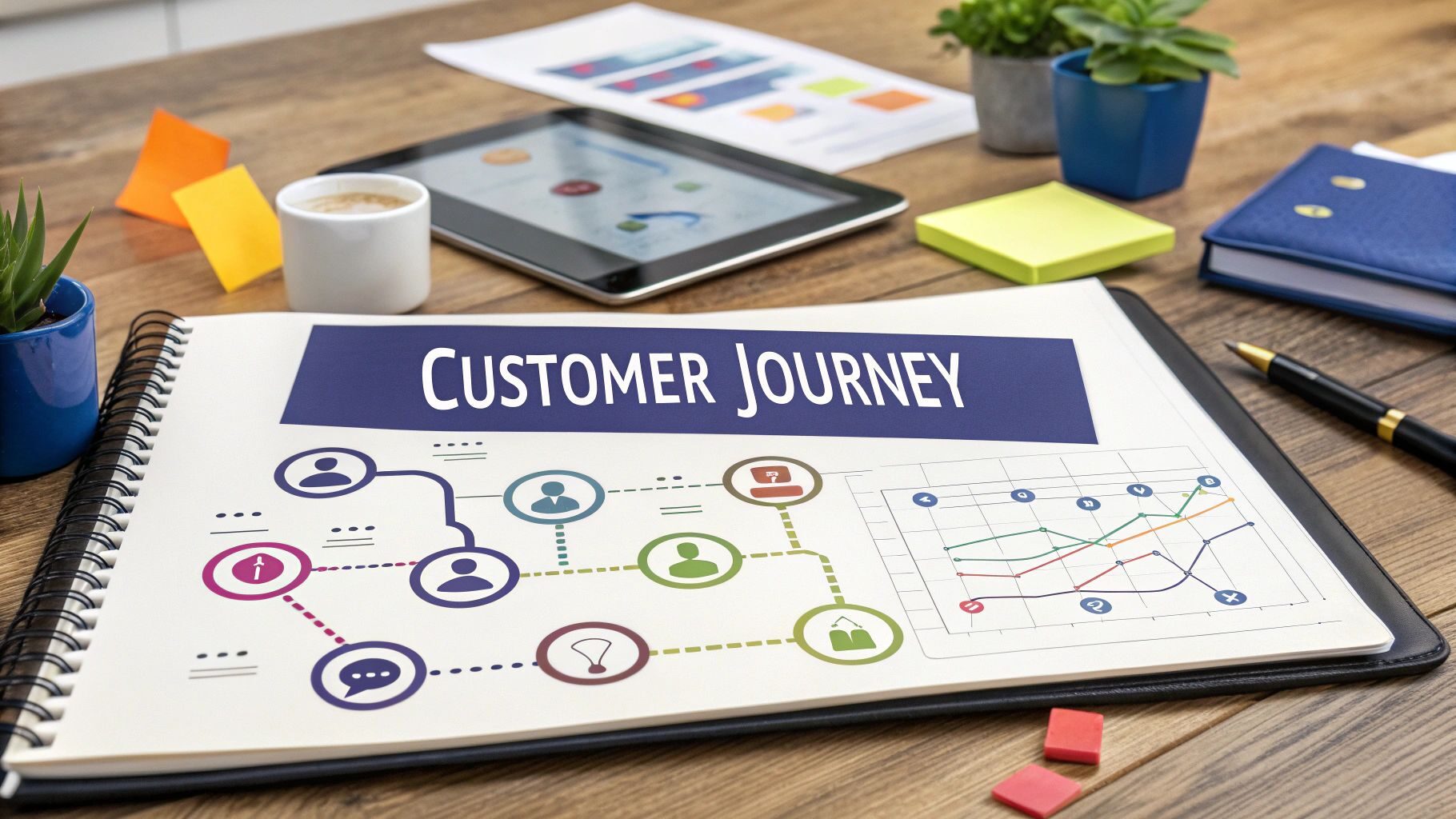
Think of it as creating a visual story of every single interaction someone has with your business. It's not just a flowchart; it's a detailed road map that traces the entire experience from your customer's point of view. It captures every thought, feeling, and action they take, from the moment they first hear about you to the day they become a raving fan. A well-executed map gives you actionable insights to improve every touchpoint.
Seeing Your Business Through Your Customer's Eyes
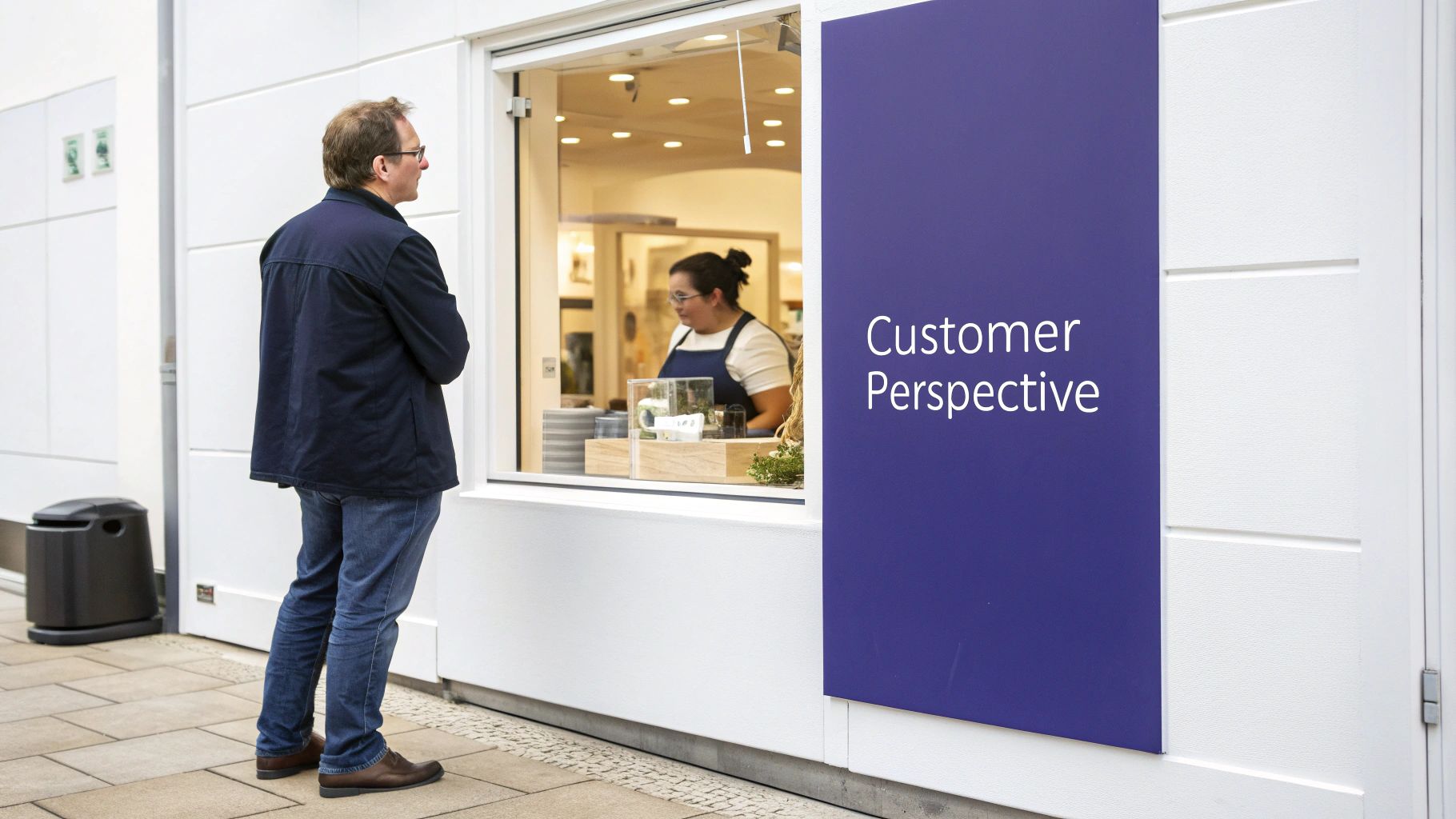
Trying to run a business without truly understanding your customer’s perspective is like giving a friend directions using a map you drew from memory. You might get the big picture right, but you're bound to miss the crucial turns, frustrating roadblocks, and hidden gems along the way.
Customer journey mapping is the tool that forces you to flip the script. It gets you out of your internal, company-centric bubble and into an empathetic, customer-first mindset.
It’s about quite literally stepping into your customer's shoes to see your brand, your products, and your service as they actually experience them. This isn't about spreadsheets and assumptions; it's about connecting with the real, human side of your business.
Why This Perspective Is a Game Changer
When you start visualising this path, you uncover the moments that truly matter. You’ll pinpoint the highs that spark delight and create fans for life, but you’ll also find the lows—the points of friction that cause frustration and drive people away. It’s far more than just a technical exercise; it’s a powerful strategy for building genuine, lasting loyalty.
"A journey map challenges your assumptions about when the journey truly begins and ends, thus identifying as many opportunities for innovation as possible.” – Srikant Datar, Dean of Harvard Business School
This empathetic approach is the very foundation of a stronger, more intuitive customer experience. It helps you design interactions that feel natural, supportive, and human, rather than cold and transactional. If you're keen to dig deeper into this, you can learn more about the critical link between user experience and success by exploring the UI and UX meaning.
Mapping Beyond Your Industry
The beauty of journey mapping is that its principles are universal, unlocking powerful insights across completely different sectors. For a fantastic real-world example, take a look at a practical guide to student journey mapping, which breaks down the detailed interactions students have with an educational institution.
It’s a perfect illustration of how any organisation, in any field, can benefit immensely from seeing its world through the eyes of the people it's there to serve.
Why Journey Mapping Is Your Business Superpower
Think of your customer's journey as a story. Are you just a minor character, or are you the helpful guide who leads them to a happy ending? This is where journey mapping comes in—it’s less of a marketing task and more of a strategic superpower. It’s your way of stepping out from behind your own desk and seeing your business exactly as your customers do.
This process gives you an almost uncanny ability to get inside their heads. A great map doesn’t just track clicks and purchases; it uncovers the thoughts, feelings, and frustrations that drive every decision. This is where the magic happens. You start to see the "moments of truth"—those critical points where a customer's loyalty is either won or lost for good.
Suddenly, this single document becomes the glue that holds your entire company together. Marketing isn't just focused on leads anymore, sales isn't just about closing, and support isn't just about tickets. Everyone—from product developers to content writers—is rallied around a shared, crystal-clear vision of the customer experience, all singing from the same hymn sheet.
From Friction to Flow
Let's be honest, without this bird's-eye view, businesses often create friction without even realising it. A confusing checkout page, an email that lands at the wrong moment, or a support chat that feels robotic—these are the tiny bumps in the road that can cause a customer to turn back.
Customer journey mapping acts like a powerful floodlight, illuminating all those hidden pain points and turning them into golden opportunities to delight.
By visually laying out the entire experience from start to finish, you can pinpoint the exact spots where a small tweak can make a monumental impact. This is how you turn a one-time buyer into a lifelong fan.
It’s the difference between shouting a generic message to a crowd and having a meaningful one-on-one conversation. This deep level of understanding allows you to craft experiences that feel personal and intuitive, which is the secret to building trust and keeping customers coming back.
Real-World Impact in a Diverse Market
This approach is especially powerful in a vibrant and complex market like India, where the customer’s path is anything but linear. Indian consumers are incredibly savvy; they might discover a product on YouTube, ask for opinions on WhatsApp, and finally make a purchase through a mobile app.
For example, a clothing brand in Jaipur noticed a high number of abandoned carts. After mapping out their checkout journey, they simplified the steps and saw a 15% boost in completed orders. In Bangalore, a fintech startup introduced chatbots in Hindi and Kannada after realising language was a barrier, leading to a massive spike in user satisfaction. These aren't just feel-good stories; they're proof that mapping your specific audience's journey directly translates to better conversions and healthier revenue. You can discover more about how Indian brands are using this strategy on merabhai.com.
When you truly commit to journey mapping, you’re doing more than just drawing a diagram. You're creating a living roadmap to sustainable growth, one that's built on a genuine connection with the people you're here to serve.
The Five Essential Stages of Every Customer Journey
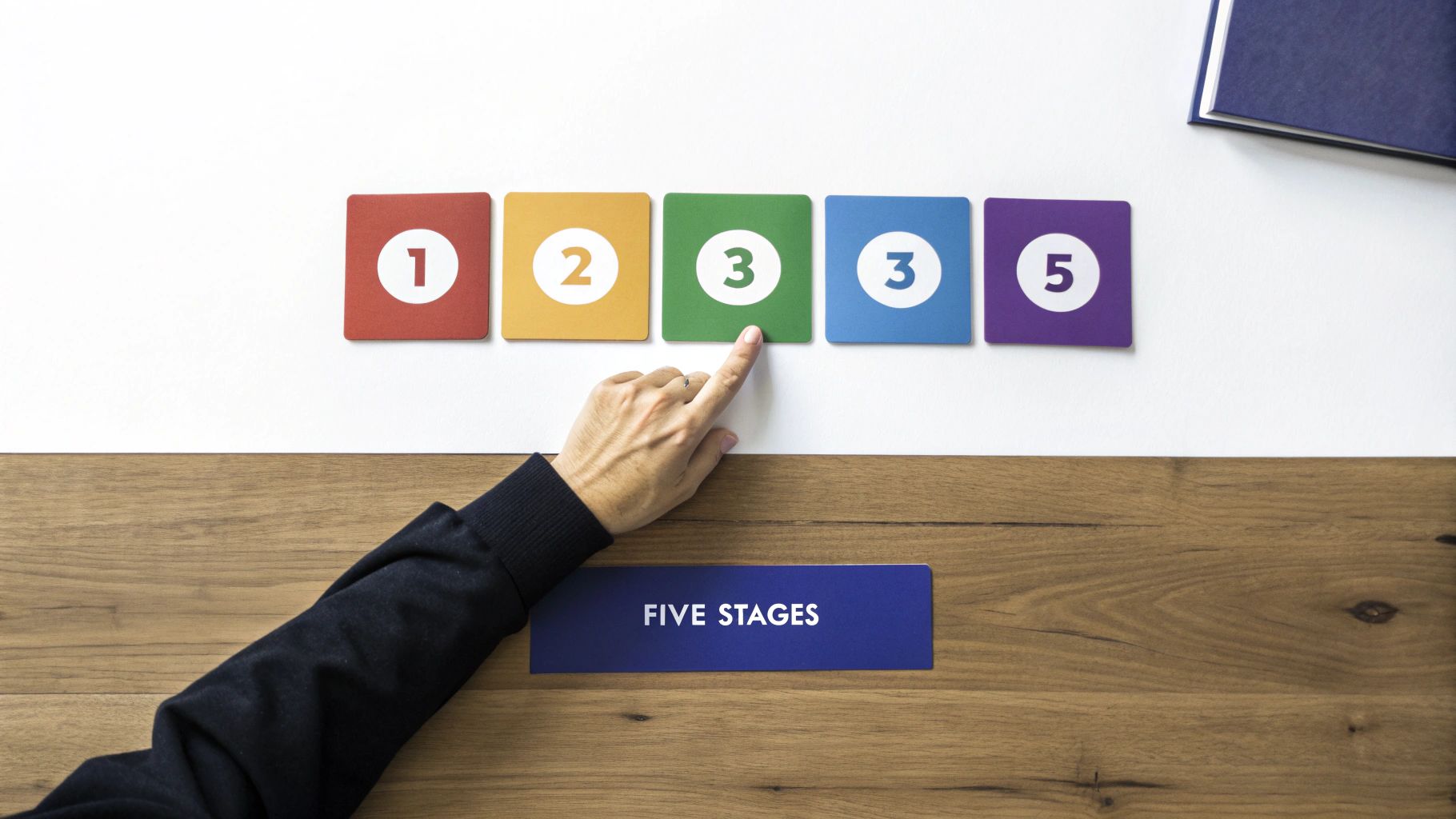
Every relationship with a customer, whether they're buying a simple coffee or signing up for enterprise software, unfolds along a predictable path. Once you understand this path, you hold the key to creating experiences that feel genuinely helpful and intuitive.
By breaking the journey down into five distinct stages, you can see exactly what your customer needs from you at any given moment. This isn't just theory—it’s a practical roadmap for meeting people where they are.
Let’s walk through these five core stages together: Awareness, Consideration, Purchase, Retention, and Advocacy. Each one marks a critical shift in how your customer thinks, feels, and acts.
Stage 1: Awareness
This is the very beginning, the "aha!" moment. Awareness is sparked when a potential customer first realises they have a problem or a need, and simultaneously discovers that your brand might just have the answer. They aren't ready to buy yet; they're simply trying to put a name to their challenge.
- Real-World Example: A startup founder feeling buried under manual invoices searches Google for "time-saving accounting tools." Your blog post on financial efficiency becomes their first touchpoint.
- Best Practice: Focus on educational content. Create helpful blog posts, infographics, or social media content that addresses common pain points without a hard sell.
Stage 2: Consideration
Now that they’re aware of their problem and some potential solutions, the deep dive begins. During the Consideration stage, your prospect is actively researching, comparing your offerings against competitors, and hunting for social proof. Their goal is to find the absolute best fit for what they need.
- Real-World Example: A home baker looking for a new stand mixer watches video reviews on YouTube, compares specs on e-commerce sites, and asks for recommendations in online forums.
- Best Practice: Provide clear, convincing proof. Detailed case studies, customer testimonials, and transparent comparison guides are invaluable here.
Stage 3: Purchase
This is it—the moment of truth. The customer has weighed their options, done their homework, and is ready to make a decision. At the Purchase stage, the focus pivots from education to action. A smooth, simple, and frictionless buying process isn't just nice to have; it's essential.
A complicated or confusing checkout is one of the quickest ways to lose a sale. In fact, an overly complex process is a leading cause of cart abandonment, making a seamless experience absolutely vital.
- Real-World Example: An online shopper adds items to their cart but finds the checkout requires creating an account and entering shipping info on multiple pages. They abandon the purchase.
- Best Practice: Remove all friction. Offer guest checkout, multiple payment options, and a clear, single-page process. For businesses aiming to nail this crucial interaction, exploring various conversion rate optimisation strategies can offer a goldmine of actionable ideas.
Stage 4: Retention
The journey is far from over once the payment is processed. The Retention stage is all about the post-purchase experience, where your mission is to deliver on your promise and ensure the customer feels great about their decision. This is where real, lasting loyalty is built.
- Real-World Example: A SaaS company sends a personalised welcome email sequence that guides a new user to achieve their first "win" with the software quickly.
- Best Practice: Be proactive and helpful. Excellent onboarding, responsive customer support, and a comprehensive knowledge base are key to turning buyers into loyal customers.
Stage 5: Advocacy
Welcome to the ultimate goal. The final and most powerful stage is Advocacy, where a happy customer transforms into a vocal champion for your brand. They don't just stick around; they actively recommend you to their friends and colleagues, write positive reviews, and become your most authentic marketers.
- Real-World Example: A customer loves their new running shoes so much they post a picture on Instagram, tagging the brand and sharing a positive review.
- Best Practice: Make it easy to share. Implement a simple referral program, send timely requests for reviews, and celebrate user-generated content on your social channels.
To help you visualise this entire flow, here's a quick breakdown of each stage in a table.
The Five Stages of the Customer Journey
| Stage | Customer Mindset | Customer Goal | Common Touchpoints |
|---|---|---|---|
| Awareness | "I have a problem or a need." | To understand and define their challenge. | Blog posts, social media, ads, word-of-mouth. |
| Consideration | "What are my options to solve this?" | To research and compare different solutions. | Reviews, case studies, webinars, product pages. |
| Purchase | "This is the best solution for me." | To complete the transaction easily and securely. | Checkout page, sales team, free trial conversion. |
| Retention | "Did I make the right choice?" | To get maximum value from their purchase. | Onboarding emails, customer support, help centre. |
| Advocacy | "I love this brand and want to share it!" | To share their positive experience with others. | Referral programs, review requests, social sharing. |
As you can see, each stage presents a unique opportunity to connect with your customer in a meaningful way, guiding them from a curious stranger to a loyal advocate.
How to Create Your First Customer Journey Map
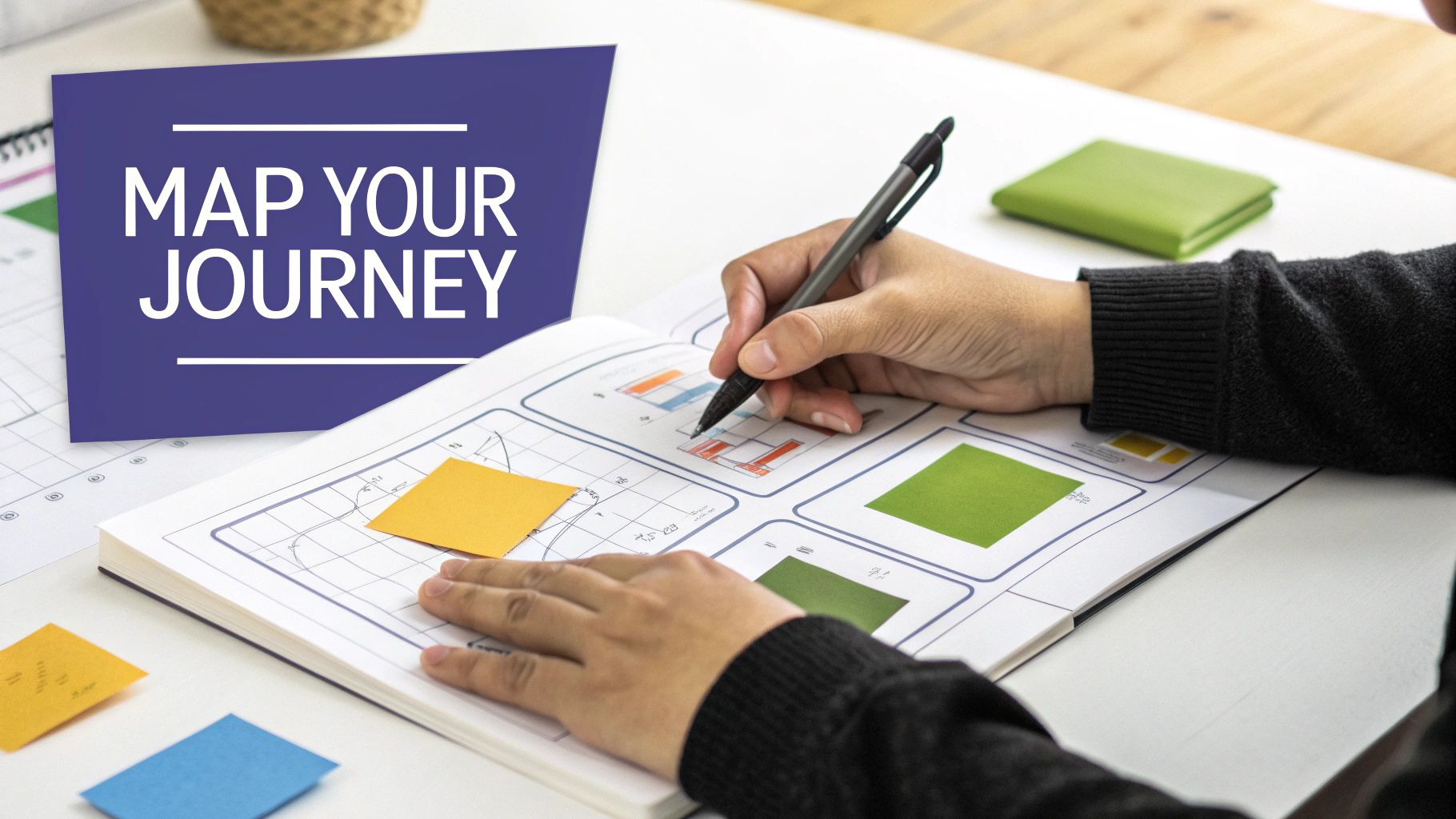
Diving into your first customer journey map can feel like a massive undertaking, but it’s really just a series of inspiring, manageable steps. This isn't about crafting a flawless document from the get-go; it's about kicking off a powerful conversation about your customer's actual reality.
Think of this as a hands-on workshop, where you’ll build a tool that unearths genuine, actionable insights. We’ll walk you through a practical, step-by-step approach that cuts through the complexity and delivers pure clarity.
Let’s get started and build something that truly moves your business forward.
Step 1: Set a Clear and Strategic Goal
Before you even think about sketching a timeline, you need to know why you're doing this. What question are you trying to answer? Without a clear goal, a journey map is just a pretty picture.
Zero in on a specific objective. Are you trying to figure out why trial users aren't converting to paid plans? Maybe you want to smooth out the onboarding for new clients or slash the friction in your e-commerce checkout.
A clear goal acts as your North Star. It ensures your map stays focused and produces real-world solutions, preventing it from becoming a purely academic exercise.
Step 2: Craft Data-Driven Customer Personas
Every great story needs a protagonist, and on your map, that’s your customer persona. This is a realistic, semi-fictional character who represents a key segment of your audience.
But this isn’t about making things up. Your personas must be built on real data. You’ll want to blend quantitative insights from your analytics with the rich, qualitative details you get from customer interviews and surveys. A solid persona brings your customer's goals, motivations, and frustrations to life.
Step 3: Identify All Customer Touchpoints
Next up, it’s time to brainstorm every single point where a customer interacts with your brand. A touchpoint is any moment of engagement, no matter how big or small.
This is a deep dive, so you'll need to be thorough. Be sure to include:
- Digital Interactions: Your website, social media posts, blog articles, online ads, and email newsletters.
- Human Interactions: Calls with your sales team, live chats with support agents, or conversations at a trade show.
- Physical Interactions: Unboxing a product, visiting a physical store, or even seeing a print ad.
Try to leave no stone unturned. The aim here is to create a complete inventory of the entire customer experience as it stands today.
Step 4: Uncover Emotions and Pain Points
This is the step where your map truly starts to breathe. For each touchpoint you've listed, you need to dig deep and understand what your customer is thinking, feeling, and doing.
Are they excited and optimistic during their first visit to your site? Or are they feeling confused and frustrated trying to find your pricing? Capturing these emotional highs and lows is critical because it reveals the "moments of truth"—the make-or-break points in their journey.
When you're learning what is customer journey mapping, remember that gathering honest feedback is the foundation. For some practical advice on this, check out this guide on how to collect customer feedback effectively to ensure you're getting truthful insights.
Step 5: Visualise the Complete Journey
Now it's time to bring it all together in a clear, visual format. The best journey maps tell a compelling story you can understand in a single glance.
Your final visualisation should sequence the stages, touchpoints, actions, and emotions in a logical flow. It doesn’t matter if you use a fancy digital tool or a simple whiteboard with sticky notes; the layout must be intuitive enough for your entire team to grasp. This map becomes your shared blueprint for creating a better, more human-centred customer experience.
Using Technology to Bring Your Journey Map to Life
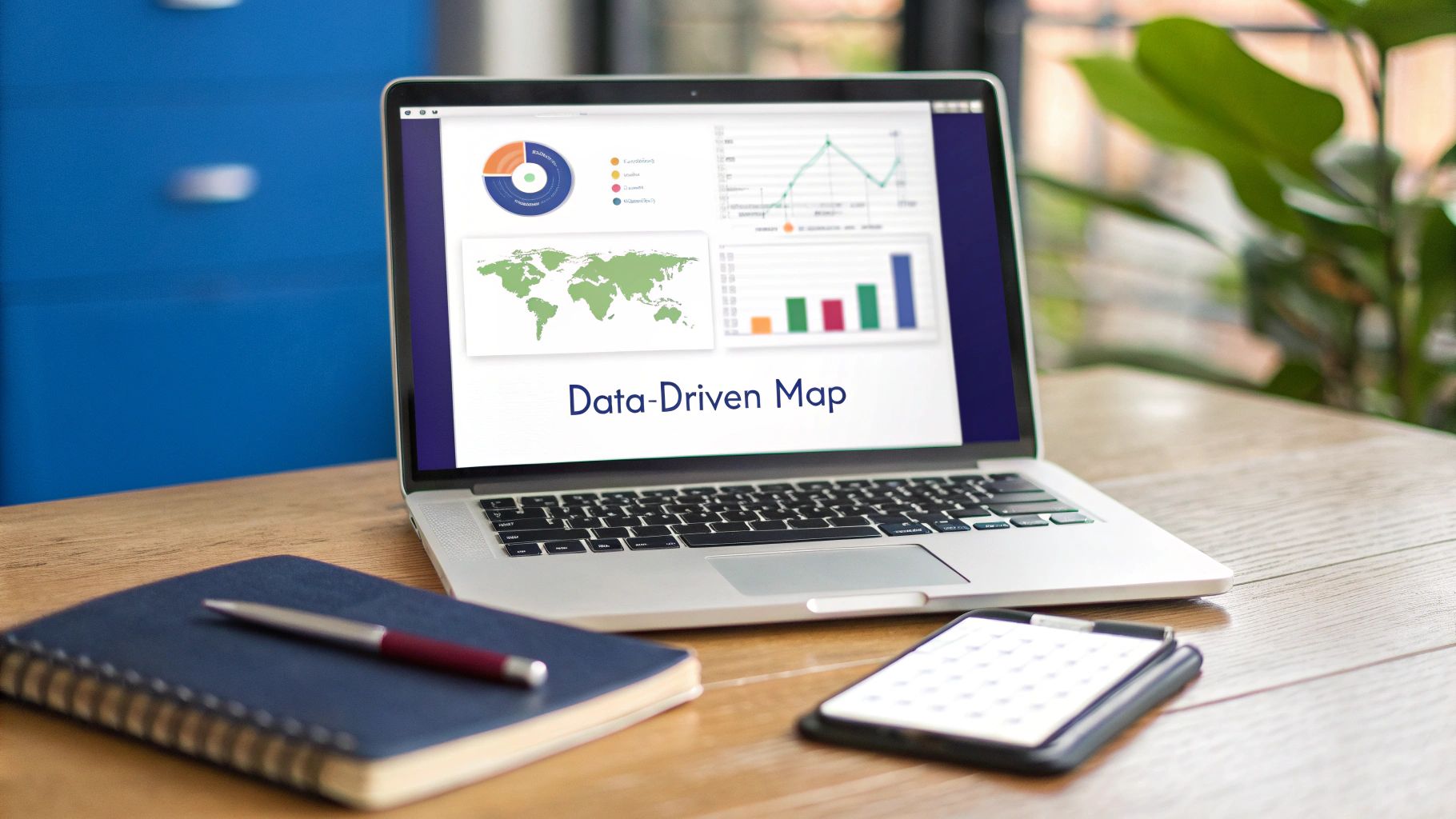
A map sketched out on a whiteboard is an incredible starting point. But a dynamic, data-driven map? That’s where you gain a real competitive edge. Technology is the bridge that turns your journey map from a static document into an active, intelligent strategy that breathes life into your customer insights.
Think of your initial map as a beautifully drawn blueprint. Now, imagine plugging that blueprint into a smart system that tracks every interaction, spots problems before they happen, and adapts to your customers’ needs in real time. That’s the true power of integrating technology with your mapping.
The Power of AI and Analytics
Artificial Intelligence (AI) and advanced analytics are absolute game-changers for understanding the customer experience on a profound level. While human insight is essential for building empathy, AI can process colossal datasets to spot patterns and predict behaviours that would be impossible for any team to catch on its own.
This kind of technology can automatically sift through thousands of customer support tickets, social media comments, and website clicks to flag emerging friction points. Better yet, it can power real-time personalisation at a massive scale, delivering the right message or offer at the perfect moment in the journey.
A journey map powered by technology isn't just about looking back at what happened; it's about actively shaping what happens next. It shifts you from being reactive to proactively guiding each customer toward a better outcome.
In India, the adoption of AI-driven customer journey mapping is set to dramatically improve customer experiences. Globally, 70% of companies already use AI to fine-tune their customer journey, and businesses in India integrating these tools are seeing an average 25% increase in customer satisfaction.
This technology allows companies to analyse complex data—from purchase history to social media engagement—detecting patterns to optimise journey flows and potentially reduce customer churn by up to 30%. You can learn more about how AI is shaping the future of CX on superagi.com.
Unifying Your Customer Data
One of the biggest headaches for any business is data silos. Your website analytics, CRM, and customer support platform all hold valuable pieces of the puzzle, but they rarely talk to each other. This is exactly the problem that dedicated journey analytics platforms are designed to solve.
These tools connect all your separate data sources, stitching them together to create a single, authoritative view of every customer's path. This unified perspective is the foundation for making genuinely informed decisions.
Working with a data-driven marketing agency can help you select and implement the right platforms, turning all those isolated data points into a cohesive story.
By using the right tools, you move beyond simply understanding what is customer journey mapping and start using it as an engine for continuous improvement and growth.
The Future of Customer Experience Is Predictive
For years, we’ve used customer journey maps to look back at what happened—to analyse the paths people took. But the ground is shifting beneath our feet. The future isn’t about just understanding the past; it’s about shaping what comes next.
We're moving into an era of predictive journey orchestration. This is where artificial intelligence and machine learning start playing a proactive role, optimising every interaction as it happens. Picture this: a system that senses a customer is about to get stuck and offers help before they even realise they need it. That’s where we’re heading—experiences that feel less like a transaction and more like a conversation.
As our world gets more connected, our maps get richer. We're now pulling in data from everywhere—from smart home devices and voice assistants to real-world store visits. This allows us to build a picture of the customer experience so detailed and dynamic it would have seemed like science fiction just a few years ago.
The goal is no longer just to map the journey but to dynamically steer it. We are moving towards a world where customer experiences are not just visualised but are actively and intelligently managed moment by moment.
This isn't just a niche trend; it's a booming market. Globally, the customer journey analytics space is expected to reach $20.87 billion by 2025. Here in India, the growth is staggering. Managed analytics services are expanding at a 23.8% CAGR as companies turn to AI to navigate the vast and varied digital touchpoints across the country. You can dive deeper into this expanding market on mordorintelligence.com.
Got Questions About Customer Journey Mapping? We've Got Answers.
It's completely normal to have questions when you first dive into mapping out your customer's experience. Getting these cleared up from the outset helps turn a great idea into a powerful tool that actually drives growth. Let's tackle some of the most common ones.
Who Should Be on the Journey Mapping Team?
Think of this as assembling a dream team, not a solo project. The richest, most insightful maps come from bringing different perspectives together. You'll want to pull in people from every team that interacts with your customers. We're talking marketing, sales, customer support, and product development.
Why? Because each person holds a unique piece of the puzzle. Your sales team knows the hurdles people face before they buy. Your support crew understands the frustrations that pop up after the purchase. Getting everyone in the same room breaks down those invisible walls between departments and gives you a complete, 360-degree view of what your customer is actually going through.
Is a Customer Journey Map a "One-and-Done" Thing?
Absolutely not. Your map should be a living, breathing guide—not a framed poster you hang on the wall and forget. A good rhythm is to revisit and refresh it at least once a year, or whenever something big changes in your business.
What counts as a "big change"?
- You've launched a new product or a game-changing feature.
- You're expanding into a new market or going after a different type of customer.
- You start noticing new patterns in customer behaviour or feedback.
Keeping your map current ensures it's always a reliable compass for your decisions.
A customer journey map is only as valuable as its accuracy. To keep it relevant, it must evolve alongside your customers and your business, reflecting their current reality, not yesterday's assumptions.
This commitment to keeping it fresh means you're always working with a true understanding of your customers' needs and feelings. It's the key to mastering what is customer journey mapping and using it to build real, lasting relationships.
Ready to build a marketing strategy that truly connects with your customers every step of the way? At Sun Tan Theta, we mix creative storytelling with smart, data-backed insights to create brand experiences people remember. Let's map out your path to growth together. Learn more at Sun Tan Theta.