Marketing
Ever heard of Conversion Rate Optimisation, or CRO? Think of it less as a marketing tactic and more as a growth philosophy. At its heart, CRO is a systematic process of increasing the percentage of website visitors who take a desired action. It’s a powerful practice focused on maximizing the value of the traffic you already have, rather than solely focusing on attracting new visitors. This is the blueprint for how smart businesses achieve sustainable, efficient growth.
Your Journey into Conversion Rate Optimisation

Imagine your website is a physical store. People walk in, browse, and look around, but very few make a purchase. What if you could understand why? What if you could identify the barriers, clear the path, and guide more people to the checkout? That’s precisely what CRO does for your digital presence.
This isn’t about guesswork or making changes based on a gut feeling. CRO is a disciplined, data-driven process. Instead of throwing random ideas at the wall—like changing a button from blue to green without reason—it relies on hard data and real user feedback. It’s about digging into the ‘why’ behind visitor behaviour and then testing specific, informed ideas for improvement. It’s the perfect blend of understanding human psychology and applying structured scientific experimentation.
More Than Just Technical Tweaks
Ultimately, CRO is an exercise in empathy. It’s about putting yourself in your customer’s shoes and experiencing your website from their perspective. A “conversion” isn’t always a direct sale; it’s any meaningful action a user takes that moves them along the customer journey.
- For an e-commerce brand: The primary conversion is a completed purchase. A micro-conversion could be adding an item to the cart.
- For a B2B SaaS company: A key conversion is starting a free trial or booking a demo.
- For a media site or blog: Actionable conversions include newsletter sign-ups or whitepaper downloads.
Each action deepens the relationship. Consider this: the average website conversion rate hovers around a surprisingly low 2.35%. That means for every 100 visitors, fewer than three take that critical next step. This isn’t a weakness; it’s a massive opportunity waiting to be unlocked.
Actionable Insight: A small improvement from a 2% to a 3% conversion rate isn’t just a 1% increase. It’s a 50% increase in conversions. This powerful lift is achieved without spending a single extra rupee on advertising.
Core Components of Conversion Rate Optimization at a Glance
To make this all more concrete, let’s break down the fundamental pillars of a successful CRO program. This table provides a snapshot of the structured, repeatable process.
| Component | Description | Primary Goal |
|---|---|---|
| User Research | Gathering qualitative and quantitative data through tools like heatmaps, user surveys, and analytics to understand how visitors behave. | Identify friction points and uncover why users aren’t converting. |
| Hypothesis | Forming a clear, testable statement based on research. For example: “Changing the CTA from ‘Submit’ to ‘Get My Free Quote’ will increase form fills.” | Create an educated guess about a change that will lead to a positive outcome. |
| A/B Testing | Creating two or more versions of a page (e.g., A and B) and showing them to different segments of your audience to see which one performs better. | Scientifically validate the hypothesis and determine which version drives more conversions. |
| Analysis | Reviewing the test results to determine a winner, understand the impact, and learn from both successes and failures to inform future tests. | Extract actionable insights to continuously improve the user experience and business results. |
This cycle of research, hypothesising, testing, and analysing is what separates true CRO from simply making random changes and hoping for the best.
Understanding the Bigger Picture
CRO doesn’t exist in a vacuum; it’s the engine that amplifies all your other marketing efforts. The traffic you work so hard to acquire from SEO, social media, and paid campaigns will deliver far better returns when the destination—your website—is optimised to convert. A deep dive into customer journey optimization is a great next step, as it helps you see the entire path your customers take.
At the end of the day, CRO is about creating an experience that is smooth, intuitive, and genuinely helpful. When you align your users’ needs with your business goals, you transform your website from a digital brochure into a powerful growth machine that gets smarter with every single visitor. It’s a journey toward making better decisions, building a better experience, and achieving far better results.
Why CRO Is Your Business Growth Engine
It’s easy to mistake conversion rate optimisation for a purely technical job—tweaking buttons, changing headlines. But its real power is far more strategic. Think of it as the ultimate force multiplier for your entire marketing budget.
Every rupee you pour into SEO, social media campaigns, and paid ads is an investment designed to bring people to your digital doorstep. CRO is what turns those visitors into customers, ensuring your investment pays off.
Without it, you’re just pouring water into a leaky bucket. You can keep spending more to drive traffic (adding more water), but you’ll always be losing potential through the holes in your user experience. CRO is the process of finding and fixing those leaks, one by one, so every drop of effort counts.
This simple idea completely shifts your focus. Instead of endlessly chasing more traffic, you start asking a much smarter question: “How do we get more value from the traffic we already have?”
Maximising Your Marketing ROI
Let’s look at a practical example. Imagine an e-commerce company spends ₹1,00,000 a month on Google Ads, driving 10,000 visitors to a key product page. If that page converts at a typical 2%, they generate 200 new customers.
Now, let’s apply a CRO mindset. After analysing user behaviour and running A/B tests, they manage to lift that conversion rate from 2% to just 3%. It sounds like a small change, but the business impact is massive.
- Before CRO: 10,000 visitors x 2% conversion rate = 200 customers
- After CRO: 10,000 visitors x 3% conversion rate = 300 customers
With that one-percent-point improvement, they’ve gained an extra 100 customers—a 50% increase in conversions—without spending a single additional rupee on their ad budget. That’s the power of CRO. It makes every other marketing channel you use more profitable and sustainable.
Building a Lasting Competitive Advantage
The immediate financial wins are great, but the long-term value of CRO is even bigger. It helps you build a competitive moat around your business that’s incredibly difficult for anyone else to copy. Why? Because it’s not about mimicking tactics; it’s about deeply understanding your customers.
When you optimise for conversions, you’re forced to learn what truly motivates your audience. You uncover their hidden anxieties, answer their unspoken questions, and build a digital experience that feels genuinely helpful and trustworthy.
Best Practice: A superior user experience is a powerful differentiator. A website that’s easy and enjoyable to use doesn’t just convert better—it builds brand loyalty, encourages repeat business, and generates positive word-of-mouth.
This customer-first mindset is a cornerstone of the broader discipline known as growth marketing, which is all about creating sustainable, data-driven expansion. You can see how these ideas fit together by exploring our resources on what is growth marketing.
Ultimately, when you invest in CRO, you’re investing in customer intelligence. You’re not just changing button colours; you’re building a business that listens, learns, and adapts to what its users actually need. This creates a powerful feedback loop where better experiences drive more conversions, which in turn fuels more growth. It’s the engine that powers smart, scalable, and lasting success.
The A-R-T Framework for Repeatable Success

Ambition and big ideas are great, but they won’t get you very far without a plan. To truly turn your website into a growth engine, you need a repeatable process—a reliable system that turns insights into action and, most importantly, action into results. That’s exactly what the A-R-T Framework is designed to do.
It’s a simple, memorable, and incredibly powerful three-step cycle: Analyse, Research, and Test.
Think of it as your compass for navigating the often-confusing world of conversion rate optimisation. It gives you a structured path to follow, taking the guesswork out of the equation and replacing it with a data-informed methodology. Let’s break down how this powerful framework empowers you to find sustainable success.
Step 1: Analyse Where Your Users Struggle
The first step in any real CRO journey is to put on your detective hat. The Analyse phase is all about digging into your quantitative data to uncover where the problems are happening. You’re looking for the digital breadcrumbs that lead you straight to the friction points in your user journey.
This isn’t about making assumptions; it’s about letting the numbers tell the story. Your goal here is to pinpoint the exact pages, forms, or steps in a process where a significant number of visitors are dropping off.
Actionable Best Practices for Analysis:
- Use Web Analytics: In tools like Google Analytics, trace the user flow to find pages with high exit rates. Pay close attention to your conversion funnel (e.g., checkout or sign-up process) to see where users abandon the journey.
- Leverage Heatmaps: Visual tools show you exactly where users are clicking, how far down a page they scroll, and which elements they ignore. A heatmap might reveal that a critical call-to-action is placed “below the fold” where nobody sees it.
By the end of this stage, you’ll have a clear map of your website’s performance, with bright red flags marking the exact locations of potential conversion roadblocks.
Step 2: Research Why It Is Happening
Once you know where users are struggling, the next question is the most important one you can ask: why? The Research phase is about gathering qualitative insights to understand the human behaviour behind the data. If analytics tells you what is happening, research tells you the story behind it.
This is where you move beyond numbers and connect with the real experiences of your audience. You’re trying to understand their motivations, frustrations, and the questions your website isn’t answering.
Actionable Best Practices for Research:
- Deploy On-Page Surveys: Ask simple, direct questions on high-drop-off pages. A small pop-up asking, “Is there anything stopping you from signing up today?” can provide invaluable, in-the-moment feedback.
- Watch Session Recordings: Watch anonymised recordings of real user sessions. There is nothing more powerful than witnessing firsthand as someone repeatedly tries and fails to click a broken link or struggles to find key information.
- Gather User Feedback: Use tools that allow visitors to highlight specific page elements and leave comments, giving you direct, contextual insights into what’s confusing or frustrating them.
This combination of quantitative analysis and qualitative research gives you the full picture, empowering you to move forward with informed ideas instead of blind guesses.
Step 3: Test Your Ideas and Learn
With a solid understanding of where and why users are getting stuck, you’re ready for the final step: Test. This phase is about turning your insights into a structured experiment to see if your potential solution actually works. You’ll create a clear hypothesis and then run a controlled test—most commonly an A/B test—to prove whether your proposed change improves conversions.
Best Practice for Hypotheses: A strong hypothesis is the bedrock of any good test. It should follow a simple structure: “If we [make this specific change], then [this specific metric] will improve because [this reason based on your research].”
For example: “If we change the CTA button text on our pricing page from ‘Submit’ to ‘Start My Free Trial,’ then sign-ups will increase because the new text clarifies the immediate value and reduces user anxiety.”
This disciplined approach ensures you are learning from every single experiment. You are no longer just changing things on a whim; you are systematically improving your user experience based on real data and feedback.
The A-R-T Framework in Action: A Financial Services Case Study
To see just how powerful this process is, let’s look at a real-world example. A financial services company noticed an alarming drop-off rate on its multi-step loan application form. They were getting plenty of traffic, but very few people were actually making it to the end.
- Analyse: Using analytics, they pinpointed the exact step where most users abandoned the form—the section demanding detailed financial information.
- Research: They deployed on-page surveys and discovered users felt the form was too long, the questions were intrusive, and they weren’t sure if their data was secure. They lacked trust.
- Test: They formed a hypothesis: “If we break the form into smaller steps, add trust signals like security badges and customer testimonials, and clarify the language, then form completions will increase.”
They ran an A/B test comparing the old form to the new, optimised version. The results were astounding. The new version, designed with user feedback at its core, led to a dramatic increase in completed loan applications.
This success isn’t a one-off. IMB Bank in Australia, for instance, saw an 87% surge in loan application conversions after a similar optimisation process. They integrated their Unique Selling Propositions (USPs) and trust signals directly into the form—a strategy that has helped push finance CRO rates in India to an average of 3.1%. You can discover more insights about these conversion rate optimisation statistics on meetanshi.com.
This case study perfectly illustrates the A-R-T Framework. It’s not about a single magic trick; it’s about a disciplined, repeatable process that puts the user at the centre of every single decision.
Building Your Essential CRO Toolkit
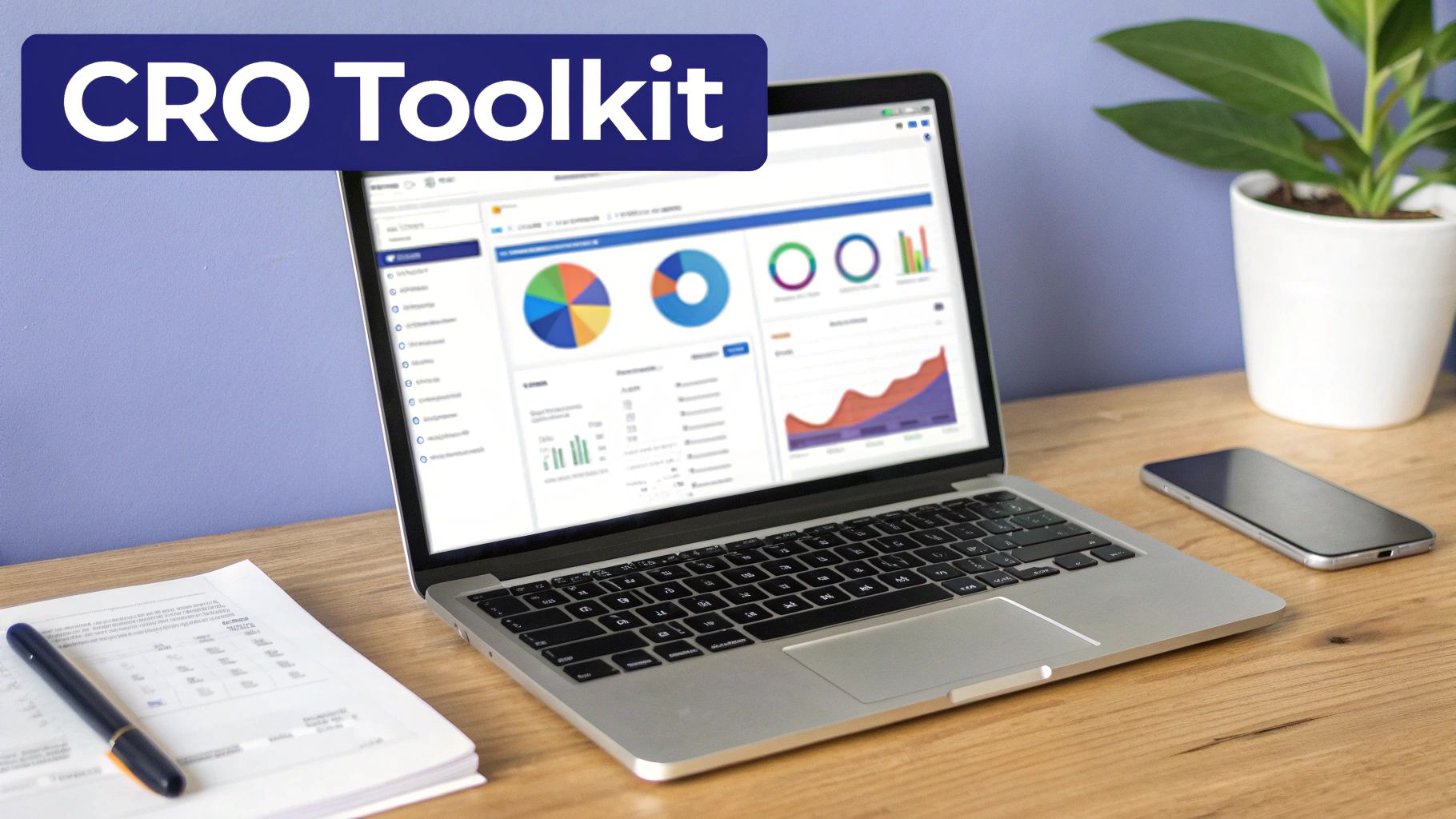
To bring the A-R-T framework to life, you need the right instruments. A brilliant conversion rate optimisation strategy isn’t about hoarding every tool under the sun; it’s about carefully selecting the right tools for the job. Think of this as your essential toolkit, curated to give you clarity, not clutter.
Before diving into software, let’s focus on the metrics that actually tell a story about your user experience. These numbers are more than just data—they’re clues that whisper how people feel and act on your website.
Key Metrics That Tell a Story
A handful of core metrics are absolutely fundamental. They form the quantitative bedrock for the ‘Analyse’ phase of your CRO process, pointing you exactly where you need to start digging.
- Conversion Rate: This is your North Star. Calculated as (Number of Conversions / Total Visitors) x 100%, it’s the most direct measure of your success.
- Bounce Rate: The percentage of visitors who land on a page and leave without taking any action. A high bounce rate often signals a disconnect between what a user expected and what they found.
- Exit Rate: This shows the percentage of visitors who leave your site from a specific page. It’s crucial for identifying the weak links in your conversion funnel.
- Cart Abandonment Rate: For e-commerce, this is a vital health metric. It tracks how many people add items to their cart but leave before completing the purchase, often due to friction like unexpected shipping costs.
By keeping a close eye on these metrics, you can quickly spot the leaks in your conversion funnel and decide where to focus your energy first.
Your Curated List of CRO Tools
Once you know which numbers to watch, it’s time to arm yourself with the right technology. These tools are grouped to align perfectly with the A-R-T framework, helping you move smoothly from analysis to real-world testing.
Essential CRO Tools by Category
Building a powerful CRO stack doesn’t have to be complicated. The key is to select tools that excel at specific jobs within your optimisation process. Below is a simple breakdown of the essential categories and some of the best tools for each task.
| Category | Tool Example | Primary Use Case |
|---|---|---|
| Analytics Platforms | Google Analytics | Uncovering what is happening on your site and where the problems are by tracking user flow. |
| Behavioural Tools | Hotjar | Understanding the why behind user actions with heatmaps, scroll maps, and session recordings. |
| A/B Testing Software | VWO | Scientifically testing your hypotheses to see which changes actually improve conversions. |
This curated stack gives you a complete, end-to-end system for identifying problems, understanding their root causes, and validating your solutions with hard data.
1. Analytics Platforms (The ‘Analyse’ Engine)
These tools are your starting point, giving you the foundational data about what’s happening on your site.
- Google Analytics: The industry standard for a reason. This powerhouse platform helps you track user flow, pinpoint high-exit pages, and segment your audience to see how different groups behave. It’s essential for uncovering the ‘where’ of your conversion problems.
2. Behavioural Insight Tools (The ‘Research’ Magnifying Glass)
Once analytics shows you where the problems lie, these tools help you understand why they’re happening.
- Hotjar: This tool is famous for its heatmaps, which give you a stunning visual of where users click, move, and scroll. It also offers session recordings, letting you watch anonymised user journeys as if you were looking over their shoulder. It’s an incredible way to build empathy and spot user frustration in real-time. Crafting a seamless user journey is a huge part of good interface design, and tools like Hotjar show you exactly where your design is getting in the way.
Best Practice: Combine quantitative data from analytics with qualitative insights from behavioural tools. The numbers tell you what is happening, but the human story tells you why.
3. A/B Testing Software (The ‘Test’ Laboratory)
After you’ve formed a hypothesis from your analysis and research, you need a way to prove it.
- VWO (Visual Website Optimizer): This is a user-friendly yet incredibly powerful tool that lets you easily set up A/B tests, split URL tests, and even more complex multivariate tests. Its visual editor makes it a breeze to create different versions of a page without touching a line of code, empowering you to test changes fast and measure their impact with precision.
To truly grasp the impact of your CRO efforts, it’s crucial to have robust conversion tracking in place. This is what connects your tests directly to real business outcomes. By combining these three types of tools, you create a powerful, closed-loop system for continuous improvement.
Powerful CRO Wins You Can Implement Today
You don’t need a massive budget or a dedicated team to start seeing real improvements in your conversion rates. The journey of optimisation begins with small, deliberate steps that deliver genuine results. These “quick wins” are high-impact, actionable changes you can make right now to remove friction and guide more visitors toward your goals.
Think of it as clearing a path for your customers. Each tactic addresses a common roadblock that causes hesitation, making the decision to convert feel both natural and easy.
Craft Compelling Calls to Action (CTAs)
Your CTA is often the most important button on a page. Vague, generic phrases like “Submit” or “Click Here” are lifeless and fail to motivate users.
Actionable Best Practice: A powerful CTA answers the visitor’s question, “What’s in it for me?” It should be action-oriented and communicate clear value.
- Instead of “Submit,” try “Get My Free Quote.”
- Instead of “Sign Up,” try “Start My 14-Day Free Trial.”
- Instead of “Download,” try “Download Your Free E-book.”
This simple switch in language turns a dry command into an exciting benefit, aligning it perfectly with your visitor’s goal.
Simplify Your Forms to Reduce Friction
Every field you add to a form is another potential reason for someone to give up. A long, complex form feels like a chore and can trigger privacy concerns. The golden rule is to only ask for what is absolutely essential at that moment.
Actionable Best Practice: Review your forms. Can you remove any fields? Could you break a long checkout process into smaller, manageable steps with a clear progress bar? Simplifying forms is one of the fastest ways to slash abandonment and boost completions.
Friction is the enemy of conversion. The easier you make it for someone to take the desired action, the more likely they are to do it.
Harness the Power of Social Proof
People are far more likely to trust their peers than your marketing copy. Strategically placing social proof on key pages can dramatically increase credibility and reduce visitor anxiety.
Actionable Best Practice: Place these trust signals near your CTAs:
- Customer Testimonials: Short, powerful quotes from happy customers.
- Star Ratings and Reviews: Especially effective on product or service pages.
- Client Logos: Showing well-known brands you’ve worked with builds instant authority.
Optimise Your Site Speed
In an impatient world, speed is everything. Slow-loading pages are a primary cause of high bounce rates. Even a one-second delay can significantly impact conversions.
Actionable Best Practice: Use free tools like Google’s PageSpeed Insights to diagnose what’s slowing you down. Common culprits include large image files and messy code. Compressing images and enabling browser caching are quick technical fixes that directly improve the user experience and, consequently, your conversion rate. For more ideas, check out our guide to proven conversion rate optimization strategies.
A brilliant real-world example comes from ACT Fibernet in India. The telecom company boosted its customer acquisition by a remarkable 25% simply by personalising its landing pages for different cities and optimising its CTAs. Just by tweaking those call-to-action buttons, they achieved a 6% higher conversion rate on those elements alone. You can read the full analysis of CRO case studies on fibr.ai. It’s a perfect illustration of how focused, simple changes can drive incredible growth.
Common CRO Mistakes and How to Avoid Them
We’ve all been there. Every expert was once a beginner, and the road to mastering conversion rate optimisation is littered with lessons learned the hard way. It’s easy to get excited and dive right in, but a few classic missteps can quickly send your efforts off the rails. The trick is to see these moments not as failures, but as the very experiences that forge a truly great CRO programme.
Think of this as your field guide to navigating the common traps. By knowing what they are ahead of time, you can build a smarter, more effective optimisation strategy right from the start.
Testing Without a Solid Hypothesis
This is the most common mistake: testing random ideas. “What if we make the button red?” It feels productive, but without a research-backed hypothesis, you’re just guessing. This leads to results you can’t explain or build upon.
The Fix (Best Practice): Never test without a hypothesis. Every experiment must be rooted in the A-R-T framework. A proper hypothesis is a structured statement: “If we implement [specific change], then we expect [specific metric] to improve because [specific user insight].” This discipline turns every test—win or lose—into a valuable lesson about your customers.
A test without a hypothesis is just a shot in the dark. A test with a hypothesis is a calculated experiment designed to generate knowledge.
Ending Experiments Too Soon
In CRO, patience is a requirement. It’s tempting to peek at results after a couple of days and declare a winner. But ending a test too early means you might be making a huge decision based on a random fluctuation, not a real trend. This is about reaching statistical significance.
The Fix (Best Practice): Aim for at least 95% statistical confidence before trusting the outcome. Use an A/B test significance calculator to be sure. It’s also crucial to let tests run for full business cycles—at least one or two weeks—to smooth out the natural ups and downs of daily traffic.
Blindly Copying Your Competitors
I see this one all the time. A competitor rolls out a new homepage layout, and suddenly, everyone else in the industry scrambles to do the same. While monitoring competitors is smart, you have no insight into their strategy, their audience, or whether their test was even a success. What works for their brand might completely tank your conversions.
The Fix (Best Practice): Use competitors for inspiration, not as a blueprint. If you see a change they made, ask why. What user problem were they trying to solve? Use that question to form your own hypothesis, and then test it on your audience. Genuinely understanding what is conversion rate optimization is about deeply understanding your own users, not someone else’s.
Your CRO Questions Answered
As you start putting conversion rate optimisation into practice, you’re bound to have questions. This is where theory meets reality- making smart decisions that actually grow your business. Let’s clear up some of the most common queries.
First, “How long should I run an A/B test?” There’s no magic number of days. The real goal is to reach statistical significance (usually a 95% confidence level), ensuring the results aren’t a fluke. Best Practice: Let tests run for at least one full business cycle (typically one to two weeks) to account for daily variations in user behaviour.
Another frequent question is, “What’s a ‘good’ conversion rate?” While you’ll see global e-commerce averages floating around 2-5%, that number can be misleading. Your industry, price point, and audience all change the game. The only benchmark that truly matters is your own. The point of CRO is continuous improvement – to be better than you were yesterday.
How Does CRO Look Different in India?
Understanding the local market is crucial. For example, India’s e-commerce Food & Beverage sector recently hit an incredible average conversion rate of 8.98% – miles ahead of global standards.
But here’s a key insight: despite that massive potential, a shocking 68% of small businesses in India are not implementing any CRO practices. They are leaving money on the table, while competitors who are adopting CRO are seeing AI-powered conversion gains of up to 25%. You can dig into more of these regional CRO stats on sqmagazine.co.uk.
Ultimately, CRO is a journey of endless curiosity and learning. Stay focused on what your users are telling you, embrace the process, and celebrate every small win. Each question you ask and answer sharpens your skills, turning your website into a growth engine that gets smarter with every single test.
Ready to turn insights into measurable growth with a partner that blends creativity and data? Sun Tan Theta helps ambitious brands build an effective online presence with clarity, not vanity. Discover our fractional marketing services and see how we can help you grow.