
Marketing
Today, visibility is everything. For a small business, mastering Search Engine Optimisation (SEO) is not just a marketing tactic; it is a fundamental pillar for sustainable growth and a direct line to potential customers actively searching for your products or services.
Many entrepreneurs feel overwhelmed by complex algorithms and technical jargon, but effective SEO does not require a massive budget or a dedicated in-house team. It demands a clear, actionable strategy grounded in proven practices. This guide breaks down 10 essential, real-world SEO tips for small business owners, focusing on practical steps you can implement immediately to attract more organic traffic, build brand authority, and drive measurable results.
We will move past abstract theory and dive straight into the ‘how-to’. Each point is designed to be a concrete action, complete with real-world examples to help you navigate your journey to the top of search engine results. By applying these strategies, you can begin turning clicks into loyal customers and unlock your company’s true digital potential. Let’s begin.
1. Conduct Thorough Keyword Research
Keyword research is the cornerstone of any effective SEO strategy, acting as the roadmap for your content and optimisation efforts. It involves identifying the specific words and phrases your potential customers type into search engines like Google when looking for your products or services. For a small business, this process is not about targeting the broadest terms; it’s about finding specific, achievable opportunities that connect you directly with a ready-to-convert audience.

This foundational step ensures your content aligns with user intent—what a searcher actually wants to accomplish. Focusing on the right keywords is one of the most critical seo tips for small business owners because it prevents you from wasting resources creating content no one is looking for.
How to Implement Keyword Research
Start by brainstorming a list of core topics related to your business. Then, use tools like Google Keyword Planner, Ahrefs, or SEMrush to expand these topics into specific phrases. Analyse these for search volume (how many people search for it), competition (how hard it is to rank for), and intent (informational, navigational, or transactional).
For example, a local bakery in Bengaluru should target “custom birthday cakes in Koramangala” instead of the highly competitive term “cakes”. The first is a long-tail keyword with clear local and transactional intent. A real-world example is a small accounting firm that, instead of targeting “accounting,” successfully ranked for “quickbooks bookkeeping for startups,” attracting a niche, high-value clientele.
Actionable Best Practices
- Prioritise Long-Tail Keywords: Focus on phrases with three or more words, like “eco-friendly cleaning services for small offices.” They have lower competition and higher conversion rates because the searcher’s intent is more specific.
- Analyse Competitor Gaps: Use an SEO tool to find keywords your top three competitors rank for on page two of Google. Creating superior content for these terms can be a quick win.
- Group by Intent: Organise keywords into clusters. For “what is a Roth IRA,” create an educational blog post. For “open a Roth IRA,” create a service page. This matches content to the customer journey.
- Refresh Your Strategy: Revisit your keyword research quarterly. Search trends change; use Google Search Console to find new “opportunity” keywords you’re already ranking for but could improve.
2. Optimize On-Page SEO Elements
On-page SEO involves optimising the visible and code-based components of your individual webpages to improve search engine rankings and earn relevant traffic. It tells search engines and users what your content is about, making it easier for them to understand its relevance to a search query. For a small business, mastering these elements is a direct, controllable way to signal your expertise and value.
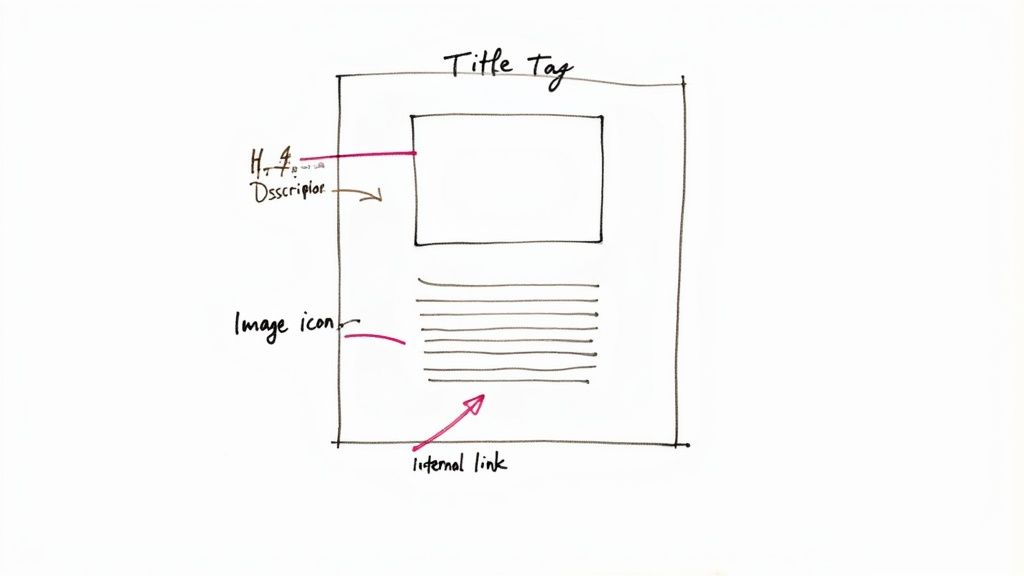
This process ensures that each page is fine-tuned to target its specific keywords, boosting its chances of ranking higher in search results. Implementing strong on-page tactics is one of the most fundamental seo tips for small business because it provides a clear framework for communicating your page’s purpose to Google, directly influencing click-through rates and user engagement.
How to Implement On-Page SEO
Start by ensuring every important page on your website has unique title tags, meta descriptions, and headers (H1, H2, etc.). These elements should naturally incorporate your target keywords. It’s about creating a clear and logical content hierarchy that guides both users and search engine crawlers through your information effectively.
For instance, a fitness studio in Mumbai should use a title tag like “Beginner Yoga Classes in Bandra | [Studio Name]” instead of a generic title like “Home”. Similarly, an e-commerce site should use clean, descriptive URLs like example.com/womens-running-shoes rather than a vague one like example.com/prod-id-789.
Actionable Best Practices
- Craft Compelling Title Tags: Place your primary keyword near the beginning of the title tag and keep it under 60 characters. A great formula is:
Primary Keyword | Secondary Keyword | Brand Name. - Write Click-Worthy Meta Descriptions: While not a direct ranking factor, a good meta description acts as ad copy. Include a call to action, like “Book a free consultation today,” to entice clicks. Keep it under 160 characters.
- Optimise Images and URLs: Use descriptive, keyword-rich filenames like
local-plumber-mumbai.jpginstead ofIMG_1234.jpg. Write descriptive alt text for accessibility and SEO. - Use Internal Linking: When writing a new blog post, find at least 2-3 older, relevant posts on your site and link to them using descriptive anchor text (e.g., “learn more about our data-driven marketing”). This distributes page authority.
3. Create High-Quality, Original Content
High-quality, original content is the fuel for your SEO engine. It involves creating valuable, comprehensive, and engaging material that directly addresses the questions and problems of your target audience. For a small business, this is how you build authority, attract natural backlinks, and engage visitors, signalling to search engines that your website is a credible resource worth ranking.
This strategy moves beyond simply stuffing keywords onto a page. It focuses on providing genuine value, which is one of the most sustainable seo tips for small business owners. When you become the go-to source of information in your niche, like HubSpot did with its marketing blog, you earn organic traffic and customer loyalty simultaneously.
How to Implement High-Quality Content Creation
Begin by identifying your customers’ most pressing pain points and questions, which you can often find in your support inquiries or sales calls. Use this insight to develop content that serves as the definitive answer. The goal is to create resources that are more thorough and helpful than anything else currently ranking for your target keywords.
For instance, a financial advisor for startups could write a comprehensive guide titled “A Complete Guide to Securing Seed Funding in India” instead of a short post on “funding tips.” This in-depth approach establishes expertise. A real-world example: a pet food company created an interactive “Dog Food Calculator” that went viral, attracting thousands of backlinks and ranking #1 for “how much to feed my dog.” For more insights, you can learn more about SEO content marketing services on suntantheta.com.
Actionable Best Practices
- Address Customer Questions: Create a “Content Ideas” document and have your sales and support teams add every customer question they receive. This is a goldmine for relevant topics.
- Write Comprehensive Guides: Aim for “skyscraper” content. Find the top-ranking article for your keyword, and create something 10x better—more up-to-date, better designed, and more detailed.
- Use Data and Original Research: Survey 100 of your customers on a key industry topic and publish the results as an original report. This type of content is highly linkable.
- Include Multimedia: Embed videos, infographics, and custom images. A blog post with a video gets significantly more engagement and time on page, which are positive ranking signals.
- Publish Consistently: Aim to publish new, high-quality content at least twice a month. A consistent publishing schedule signals to Google that your site is an active, fresh resource.
4. Build Quality Backlinks
Backlinks, or links from other websites to yours, act as votes of confidence in the eyes of search engines. They signal that your content is valuable, credible, and trustworthy. For a small business, earning high-quality backlinks from relevant, authoritative sites is one of the most powerful ways to improve your website’s domain authority and climb the search rankings.
This process is about earning trust, not just acquiring links. A single link from a respected industry publication can be more impactful than dozens of low-quality links. Focusing on a strategic backlink profile is one of the most essential seo tips for small business owners, as it directly influences how Google perceives your authority and expertise in your niche.
How to Implement Backlink Building
Begin by creating link-worthy content, such as original research, in-depth guides, or free tools. Then, identify relevant websites, industry blogs, or local directories that might be interested in your content. For example, a local accounting firm in Mumbai could earn a quality backlink by contributing a guest post on financial planning to a local business association’s blog.
Another practical strategy is “broken link building”: find a dead link on a high-authority site and offer your relevant content as a replacement. This provides value to the site owner and earns you a link.
Actionable Best Practices
- Prioritise Relevance and Authority: Focus on earning links from websites that are thematically related to your business. A link from a niche industry blog is often better than a generic news site.
- Create Original Research: Develop unique data studies or surveys. For instance, a real estate agency could publish a “State of the Local Housing Market” report and pitch it to local journalists.
- Utilise Local SEO: Get listed in reputable local directories like the Chamber of Commerce, and sponsor a local charity event in exchange for a link from their website.
- Monitor Your Profile: Regularly use tools like Ahrefs or Moz to track your backlinks. Disavow any toxic or spammy links that could harm your rankings, though this should be done with caution.
5. Optimize for Local Search
For businesses with a physical presence or a defined service area, optimising for local search is non-negotiable. This process involves a set of strategies designed to increase your visibility in local search results, such as Google’s “Local Pack” and Maps. It connects your business with nearby customers who are actively searching for the products or services you offer, often with high purchase intent.

This focus is one of the most impactful seo tips for small business because it directly drives foot traffic and phone calls. When a potential customer searches for “plumber near me,” local SEO ensures your business appears as a relevant, trusted option. For example, a dental practice in Mumbai can rank at the top of local results by optimising its Google Business Profile and gathering patient reviews.
How to Implement Local Search Optimisation
The foundation of local SEO is your Google Business Profile (GBP). Claim and fully complete your profile with accurate information, including your business name, address, phone number (NAP), hours, and service categories. Beyond GBP, focus on building local citations by getting your business listed in relevant online directories like Justdial and IndiaMART. Consistency in your NAP information across all these platforms is crucial for search engines to trust your data.
Actionable Best Practices
- Enhance Your GBP: Regularly upload high-quality photos of your storefront, team, and projects. Use the Q&A feature to proactively answer common customer questions.
- Encourage and Manage Reviews: After a successful job, send customers a direct link to your GBP review page. Make it a habit to respond to every single review within 24 hours to show you are engaged.
- Build Local Citations: Ensure your business is listed accurately on top local directories and industry-specific sites (e.g., TripAdvisor for restaurants, Houzz for contractors).
- Create Location-Specific Content: Develop dedicated service pages for each neighbourhood you serve (e.g., “Plumbing Services in Bandra”). Mention local landmarks or events to demonstrate authentic local expertise.
6. Improve Website Speed and Mobile Experience
In today’s fast-paced digital world, website speed and mobile responsiveness are no longer optional perks; they are critical ranking factors and core components of user experience. A slow-loading or poorly optimised mobile site frustrates visitors, leading to high bounce rates and lost sales. For small businesses, ensuring your website is fast and seamless on all devices is essential for capturing and retaining customer attention.

This focus on performance directly impacts your bottom line and search engine visibility. Google prioritises sites that deliver a superior user experience, making this one of the most impactful seo tips for small business owners to implement. A faster, mobile-friendly site not only ranks better but also converts more visitors into customers.
How to Implement Speed and Mobile Optimisation
Start by analysing your current performance using free tools like Google’s PageSpeed Insights and GTmetrix. These tools provide a detailed diagnosis of what is slowing your site down, from large images to inefficient code. A mobile-first design approach is crucial, as most users will likely discover your business on a smartphone.
For example, a local e-commerce store that compresses its product images and leverages browser caching could reduce its load time from 5 seconds to under 2 seconds. This simple change often results in a significant uplift in mobile conversions and a noticeable improvement in search rankings.
Actionable Best Practices
- Aim for Under 3 Seconds: Strive for a page load time of less than three seconds. Every second of delay significantly increases your bounce rate.
- Optimise Images: Use a tool like TinyPNG to compress images before uploading them. Implement lazy loading so images below the fold only load when the user scrolls to them.
- Monitor Core Web Vitals: Regularly check the Core Web Vitals report in Google Search Console. Focus on fixing issues related to LCP (loading), FID (interactivity), and CLS (visual stability).
- Choose Fast Hosting: Don’t opt for the cheapest shared hosting plan. Invest in a reliable provider with good reviews; this is the foundation of a fast website. An excellent website design is key to this process, and you can learn more about effective website design for SaaS on suntantheta.com.
7. Implement Technical SEO Fundamentals
Technical SEO is the practice of optimising your website’s backend infrastructure to help search engine bots crawl, index, and understand your content more effectively. While it may sound complex, getting the basics right is crucial. For a small business, a technically sound website ensures that all your other marketing efforts, like content creation and link building, are not wasted on a site that search engines struggle to read.
This process addresses elements like site speed, mobile-friendliness, sitemaps, and structured data. These factors are foundational; without them, even the best content can fail to rank. Focusing on these elements is one of the most impactful seo tips for small business owners because it directly influences how Google perceives your site’s quality and usability.
How to Implement Technical SEO
Start by using Google Search Console to get a clear overview of your site’s technical health. This free tool will highlight crawl errors, mobile usability issues, and other critical problems that need fixing. The next step is creating and submitting an XML sitemap, which is a file that lists all your important pages, making it easier for Google to find and index them.
For example, an e-commerce site can add product schema markup (a type of structured data) to its pages. This helps Google understand details like price, availability, and reviews, which can then be displayed as rich snippets in search results, boosting click-through rates.
Actionable Best Practices
- Monitor Crawl Errors: Once a month, check Google Search Console for “404 Not Found” errors. Redirect any broken links to a relevant live page to preserve link equity and improve user experience.
- Submit an XML Sitemap: If you use WordPress, a plugin like Yoast SEO can generate and submit your sitemap automatically. Ensure it’s submitted to Google and Bing.
- Add Schema Markup: Implement
LocalBusinessschema on your contact page to help Google understand your address and hours. UseFAQPageschema on relevant pages to try and capture rich results. - Ensure Mobile-Friendliness: Use Google’s Mobile-Friendly Test to confirm your site works well on all devices. Check that buttons are easy to tap and text is readable without zooming.
- Use HTTPS: An SSL certificate is a must-have. It secures your website, builds user trust, and is a confirmed (though minor) Google ranking signal.
8. Leverage User-Generated Content and Reviews
User-generated content (UGC), such as customer reviews, testimonials, and photos, serves as a powerful form of social proof that both search engines and potential customers value. It provides a constant stream of fresh, relevant content for your website, rich with natural language keywords and phrases that your audience uses. For a small business, leveraging UGC builds trust, credibility, and authority with minimal effort.
This strategy is one of the most effective seo tips for small business owners because it enhances your online reputation while simultaneously improving your search rankings. Google views positive reviews and consistent customer engagement as strong signals that your business is legitimate and provides a quality experience, which can directly influence local search performance.
How to Implement UGC and Reviews
Actively encourage customers to leave feedback on platforms like Google Business Profile, Yelp, or industry-specific sites. Integrate these reviews directly onto your website’s service or product pages. For example, a local service company in Mumbai can feature detailed customer testimonials on its homepage to increase conversion rates from 2% to 5% by showcasing authentic positive experiences.
Similarly, an e-commerce business can feature a gallery of customer photos using their products. This not only provides social proof but also creates unique visual content that can improve engagement and has been shown to increase sales by up to 30%.
Actionable Best Practices
- Respond to All Reviews: Thank customers for positive reviews and offer solutions for negative ones within 48 hours. A thoughtful response to a bad review can often win over prospective customers.
- Showcase Ratings in Search: Use schema markup (
AggregateRating) to display star ratings directly in search results for your products or services, which can significantly improve click-through rates. - Turn Reviews into Content: Create a blog post titled “Our Top 5 Customer-Rated Features” using direct quotes from reviews. This provides social proof and fresh content.
- Develop Case Studies: Interview your happiest customers and turn their success stories into detailed case studies. This is one of the most powerful forms of B2B content.
9. Conduct Competitive Analysis
Understanding your competitive landscape is not about copying what others are doing; it’s about identifying strategic opportunities and gaps in the market. Competitive analysis in SEO involves systematically researching your rivals to understand their strengths and weaknesses. For a small business, this insight is invaluable, allowing you to sidestep their strengths and exploit their oversights.
This process reveals which keywords are driving traffic to them, where they are getting backlinks from, and what kind of content resonates with your shared audience. Integrating this intelligence is one of the most powerful seo tips for small business owners because it provides a proven blueprint for what works in your niche, saving you time and resources.
How to Implement Competitive Analysis
Start by identifying your top 5-10 direct and indirect competitors in search results. Use SEO tools like Ahrefs or SEMrush to analyse their domain authority, organic traffic, and top-ranking keywords. Dig deeper into their content to understand its structure, format, and depth.
For instance, a local business might discover its competitors are not optimising for specific service-area keywords, creating an immediate opportunity to capture geographically-targeted traffic. Similarly, a SaaS startup could find its rival ranks for 30 valuable keywords it hadn’t even considered, instantly expanding its content strategy.
Actionable Best Practices
- Perform a Content Gap Analysis: Use a tool like Ahrefs’ Content Gap feature to find keywords your competitors rank for, but you don’t. Prioritise topics with high volume and low keyword difficulty.
- Analyse Competitor Backlink Profiles: Find out which high-authority websites link to your top three competitors. Reach out to these same sites with your superior content to try and earn a similar link.
- Create Superior Content: Find a top-ranking competitor article that is thin, outdated, or poorly written. Create a more comprehensive, up-to-date resource to “out-content” them.
- Monitor Ranking Changes: Set up alerts to track your competitors’ ranking fluctuations. If they suddenly rank for a new keyword, it could signal a shift in market trends or a new service offering.
10. Track, Measure, and Optimise with Data
SEO is not a “set it and forget it” activity; it’s a dynamic process that requires continuous monitoring and adjustment. Tracking performance data allows you to understand what’s working, what isn’t, and where to focus your resources for maximum impact. For a small business, this data-driven approach turns guesswork into a clear, strategic plan for growth.
This step is crucial because it validates your efforts and uncovers hidden opportunities. It’s one of the most vital seo tips for small business owners, as it provides the insights needed to make informed decisions, improve ROI, and consistently outmanoeuvre competitors by adapting to real-world performance metrics.
How to Implement Data Tracking
The first step is setting up free, powerful tools like Google Analytics 4 (GA4) and Google Search Console. These platforms provide essential data on your organic traffic, user behaviour, keyword rankings, and website health. This data is the foundation for all your optimisation efforts.
For example, a law firm might see in Google Analytics that their blog post “5 Things to Do After a Car Accident” gets lots of traffic but few conversions. This insight could prompt them to add a prominent “Request a Free Consultation” button within the article, directly turning traffic into leads.
Actionable Best Practices
- Set Up Essential Tools: Install Google Analytics 4 and verify your site with Google Search Console. This is non-negotiable and should be done on day one.
- Define Conversion Goals: In GA4, set up conversion tracking for key actions like form submissions, phone number clicks, or purchases. This connects your SEO efforts to actual business results.
- Monitor Key Metrics: Every month, track organic traffic, keyword rankings for your top 10 terms, click-through rate (CTR) from Google Search Console, and goal completions.
- Review and Report: Create a simple monthly report. Ask: What worked? What didn’t? Where is the biggest opportunity for next month? This turns data into action. You can learn more about becoming a data-driven marketing agency.
10 Small Business SEO Tips Comparison
| Strategy | Implementation complexity | Resource requirements | Expected outcomes | Ideal use cases | Key advantages |
|---|---|---|---|---|---|
| Conduct Thorough Keyword Research | Low–Medium — tool learning and analysis time | Keyword tools (Google KP, Ahrefs, Semrush), analyst hours | Targeted keyword list, improved content relevance | Planning content strategy, PPC keyword selection, local targeting | Focuses efforts on high-ROI terms; reveals intent and gaps |
| Optimize On-Page SEO Elements | Low — can be implemented quickly | Time for copy edits, CMS access, basic SEO plugin | Better CTR, clearer page signals to search engines | Updating existing pages, launching new pages | Immediate changes with no cost; improves UX and CTR |
| Create High-Quality, Original Content | Medium–High — sustained effort and skill | Writers, designers, research time, multimedia production | Increased organic traffic, backlinks, authority | Thought leadership, competitive niches, content hubs | Builds trust, attracts links, supports many keywords |
| Build Quality Backlinks | High — outreach and relationship-building | Outreach tools, content assets, time for outreach | Higher domain authority, improved rankings, referral traffic | Competitive niches, link-dependent search verticals | Strong ranking impact; compound long-term growth |
| Optimize for Local Search | Low–Medium — ongoing profile management | GBP, local listings, review management time | Higher visibility in local pack, more foot/phone traffic | Brick-and-mortar, service-area businesses | Highly targeted local traffic with strong conversions |
| Improve Website Speed and Mobile Experience | Medium — technical changes often required | Dev time, CDN, optimization tools, possible hosting costs | Lower bounce, higher conversions, ranking gains | Mobile-first sites, e-commerce, slow legacy sites | Direct UX and ranking benefits; better conversions |
| Implement Technical SEO Fundamentals | Medium — technical knowledge required | Dev resources, tools (Screaming Frog, GSC), audits | Improved crawlability, indexation, rich results | Sites with indexing issues, large sites, migrations | Removes critical barriers; enables other SEO efforts |
| Leverage User-Generated Content and Reviews | Low–Medium — process and moderation needed | Review platforms, tools (Yotpo), customer outreach | Fresh, trust-building content; higher conversions | Local businesses, product sites, hospitality | Produces authentic content and trust signals cheaply |
| Conduct Competitive Analysis | Medium — analytical and strategic work | Competitive tools (Ahrefs, Semrush), analyst time | Actionable gaps, quick-win opportunities, benchmarks | Market entry, strategy refinement, content planning | Identifies opportunities and informs prioritization |
| Track, Measure, and Optimize with Data | Medium — setup and ongoing analysis | Analytics tools (GA4, GSC), dashboards, analyst time | Data-driven improvements, ROI tracking, performance visibility | Ongoing SEO programs, stakeholders requiring reporting | Justifies investment; enables iterative optimization |
From Tips to Triumph: Your Next Steps in SEO
Navigating the world of Search Engine Optimisation can feel like a monumental task, but it doesn’t have to be. The journey from digital anonymity to online authority is built on the consistent application of foundational principles. We’ve explored a comprehensive toolkit, from conducting meticulous keyword research and optimising on-page elements to building a robust backlink profile and mastering the nuances of local search. Each of these seo tips for small business represents a crucial lever you can pull to drive meaningful growth.
The true power of this framework lies not in attempting to master everything overnight, but in strategic, incremental progress. Your initial focus should be on creating a virtuous cycle: produce high-quality, original content that serves your audience, ensure your website is technically sound and mobile-friendly, and then use data from your analytics to refine and repeat the process. This iterative approach transforms SEO from a complex, one-time project into a sustainable, long-term business asset.
Key Takeaways for Immediate Action
To turn this knowledge into tangible results, concentrate on these core pillars first:
- Master Your Backyard: Prioritise local SEO. Optimising your Google Business Profile and gathering genuine customer reviews are high-impact activities that can deliver rapid returns, especially for businesses with a physical presence.
- Content is Your Cornerstone: Don’t just write for search engines; write for people. Create valuable, insightful content that answers your target audience’s most pressing questions. This builds authority, attracts quality backlinks naturally, and fosters customer loyalty.
- Technical Health is Non-Negotiable: A fast, mobile-responsive website is the price of admission in today’s digital marketplace. Address core technical SEO fundamentals to ensure that both users and search engines have a seamless experience on your site.
Embracing these concepts is about more than just climbing search rankings; it’s about building a resilient, visible, and trustworthy brand. By consistently applying these strategies, you shift from passively hoping for customers to actively attracting them. You create a powerful engine for lead generation and brand building that works for you around the clock, turning your website into your most valuable marketing employee. The effort you invest in a solid SEO strategy today will pay dividends for years, establishing a competitive advantage that is difficult for others to replicate.
Ready to transform these SEO tips for small business into a cohesive, data-driven growth strategy? Sun Tan Theta is a fractional marketing studio that blends creative storytelling with analytical precision to deliver measurable outcomes. We help you build a powerful online presence without the commitment of long-term retainers. Visit us at Sun Tan Theta to see how we can bring clarity and results to your marketing efforts.